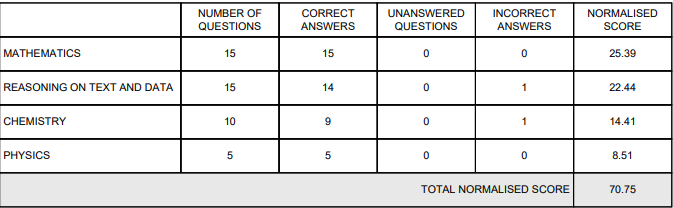
r/CENTSprep • u/Lanky_Lard • 3h ago
Everyone Mod Update
1
Upvotes
r/CENTSprep • u/ansh1282 • Feb 22 '26
First of all, sorry I was planning to write this post earlier, but due to my board exams I wasn’t able to use Reddit much.
Now about the exam…
The exam was honestly way tougher than expected. The official sample paper is not even close to the actual difficulty level. The sample felt very basic, but the real paper was much more concept-heavy and time-pressured.
🔹 Mathematics
Lots of graphs and multi-step functions. Questions were not direct formula-based. You had to think deeply about domain, interpretation, and concepts. Don’t take maths lightly just because the sample looks easy.
🔹 Physics
Conceptual and logical. Not impossible, but definitely tricky. You need clarity, not just formula memorisation.
🔹 Chemistry
Moderate but conceptual. If your basics are clear, you’ll manage.
🔹 Biology
More applied and logical than memory-based. Focus on understanding processes, not just definitions.
🔹 Logical Reasoning
This was the most time-consuming part. At first it feels difficult, but if you read carefully you can solve it. The real problem is time management. 30 minutes is very little for long paragraphs, graphs, and data-based questions. You must practice speed.
---
⚠️ My Mistakes
I trusted the sample paper too much.
I underestimated time pressure.
I didn’t practice enough long reasoning/data interpretation questions.
I didn’t simulate strict time conditions properly.
---
💡 Advice for Future Aspirants
Do NOT assume the paper will be easy.
Practice under strict time limits.
Improve reading speed.
Focus on concepts, not shortcuts.
Attempt smartly — don’t randomly guess.
Manage time carefully, especially in reasoning.
This might have been one of the toughest CEnT papers. Many students found it difficult.
But remember: if it was tough for you, it was tough for everyone.
Prepare seriously and don’t rely only on the sample paper.
All the best to everyone attempting it next. 💪
---
Ahhh this is important.
You don’t want it to sound like: “I studied everything and still exam unfair.”
You want it to sound like: “I studied properly, shared resources, but still underestimated difficulty.”
That makes you credible.
Here’s what you can add naturally inside the post 👇
---
📝 What I Studied & Shared
I didn’t take this exam casually. I completed the full syllabus topic-wise — Maths, Physics, Chemistry, Biology and Reasoning. I even created structured notes and temporary websites to organise everything properly.
I shared:
Topic-wise summaries
Important concepts
Revision sheets
Practice questions
Logical reasoning breakdown
Time-saving strategies
I genuinely tried to cover everything systematically.
But here’s what I realised:
Studying concepts is not enough.
You must also practice under real time pressure with tougher, mixed-concept questions.
The actual exam combined multiple ideas in a single question and required fast interpretation, especially in Maths (graphs/functions) and Logical Reasoning (long paragraphs, data, tables).
So even if your concepts are clear, speed and exposure to harder question patterns matter a lot.
r/CENTSprep • u/ansh1282 • Feb 15 '26
Physics is officially DONE.
Just like Chemistry, I covered everything properly and conceptually.
Because the content is too long to post fully on Reddit, I’ve created a temporary website where I uploaded all the structured notes for Physics.
I’ll share the link below.
https://cents-chemistry.lovable.app/physics
---
What I Covered in Physics:
• Mechanics (basic motion, forces, work, energy)
• Laws of motion
• Basic kinematics concepts
• Work, Power & Energy
• Basic Electromagnetism
• Optics (basic light concepts)
• Important formula understanding
• Concept clarity for numericals
---
Now status update:
✔ Maths – Completed
✔ Chemistry – Completed
✔ Physics – Completed
---
The website (Evo Centsprep) is still under development. After my CEnT-S exam, I’ll properly organize everything and make it cleaner and more structured.
For now, I’m sharing resources and notes so anyone preparing can benefit.
If you find any mistake, please correct me. We’re all learning together.
https://evocentsprep.lovable.app/
---
19 Feb is close now.
Let’s finish 💪
---
r/CENTSprep • u/Lazy_Sprinkles_8916 • Sep 11 '26
r/CENTSprep • u/Honest_Clothes8627 • Sep 08 '26
Hello 👋, could anyone please recommend biology, chemistry and physics preparation books? I'm still new to this 😁
r/CENTSprep • u/Own_Advertising_5393 • Jul 15 '26
Hey guys who has book that contains formulas and prezparation materials for cent-s in physics ,maths and logic . Please send what you have in the comments
r/CENTSprep • u/Some_Ebb_6845 • Jun 27 '26
How can I take preparation for the CEnT-S exam?? Is there any resources on internet??
Is there any courses or books??
I need help :/
r/CENTSprep • u/anilpiyancisozleri • Apr 09 '26
r/CENTSprep • u/odd-pie07 • Apr 06 '26
Hello I'm preparing for cents test but I can't find much material to practice If any of u have practice material and can share i would be very grateful
r/CENTSprep • u/Careful-Flamingo-957 • Feb 21 '26
r/CENTSprep • u/ansh1282 • Feb 16 '26
Not going to lie — I don’t have enough time to cover everything from long video lectures.
CEnT is on 19th Feb and my Class 12 Boards start from 20th Feb 😭
So instead of wasting time trying to watch hours of content, I used ChatGPT to cover the remaining Bio concepts in a structured and conceptual way.
And honestly, 😵💫😵
After my exams, I’ll definitely make deeper and more detailed notes.
---
🧬 1️⃣ GENETICS – Clear and Practical
🔹 Important Terms (You MUST not confuse)
Gene → Segment of DNA coding for traitAllele → Different version of same geneGenotype → Genetic combination (AA, Aa, aa)Phenotype → Visible trait
Homozygous → AA or aaHeterozygous → Aa
Dominant → Expressed even if one copy presentRecessive → Expressed only when both copies present
---
🔹 Mendel’s Law of Segregation
Each parent gives only ONE allele.
Example:
Aa × Aa
Possible combinations: AA, Aa, Aa, aa
Ratio: Genotype → 1:2:1Phenotype (if A dominant) → 3:1
They may not ask ratio directly.They may ask probability logic.
Example type: Two heterozygous parents. What % offspring recessive? Answer: 25%.
---
🔹 Law of Independent Assortment (Basic Idea)
Genes for different traits are inherited independently(Only true if on different chromosomes)
No need for complex dihybrid crosses.
---
🧪 2️⃣ ENZYMES (Very Important Conceptually)
Enzymes = Biological catalysts (proteins mostly)
They: • Lower activation energy• Speed up reactions• Are specific to substrate
---
🔹 Lock and Key Model
Substrate fits into active site.Shape matters.
If structure changes → enzyme stops working.
---
🔹 Effect of Temperature
Low temp → slow reactionOptimum temp → maximum activityHigh temp → denaturation (structure destroyed)
Denaturation = 3D structure lostActive site changes → no function
---
🔹 Effect of pH
Each enzyme has optimal pH.
Example: Pepsin → acidicTrypsin → basic
Wrong pH → structure change → activity drops
---
🫀 3️⃣ HUMAN PHYSIOLOGY (Functional Understanding)
No deep anatomy. Only logic.
---
🔹 Muscle Types
Skeletal → voluntarySmooth → involuntaryCardiac → involuntary + intercalated discs
Characteristic property of muscle: Excitability (respond to stimulus)
---
🔹 Respiratory System
Gas exchange happens in alveoli.
Oxygen diffuses because: High O₂ in lungs → low O₂ in blood
Diffusion = high concentration → low concentration
---
🔹 Hemoglobin & CO₂ (Bohr Effect Basic Idea)
High CO₂ + low pH in tissues→ Hemoglobin releases oxygen
Why?Because acidic condition lowers affinity for O₂.
This is why active tissues get more oxygen.
---
🔹 Circulation Flow (Very Basic)
Right side heart → lungsLeft side heart → body
Oxygenated blood: Left atrium → left ventricle → body
---
🌱 4️⃣ PLANT PROCESSES (Clarify Once)
Photosynthesis
Overall idea: CO₂ + H₂O + Light → Glucose + O₂
Important trap: Oxygen comes from WATER, not CO₂.
---
Cellular Respiration
Glycolysis → cytoplasmKrebs cycle → mitochondriaElectron transport chain → mitochondria
Produces ATP.
ATP is energy currency.
---
🦠 5️⃣ MICROBIOLOGY DIFFERENCE
Bacteria
• Prokaryotic• No nucleus• 70S ribosome• Can reproduce independently
---
Virus
• Not considered fully living• No metabolism• Needs host cell• Has DNA or RNA (not both)
---
🧠 Quick Concept Check
Tell me:
Why does high temperature reduce enzyme activity?
If Aa × aa, what % offspring will show dominant trait?
Why does hemoglobin release O₂ in active muscles?
---
🧬 1️⃣ MEMBRANE TRANSPORT (Very Important)
This is asked a lot.
🔹 Passive Transport
Moves high → low concentrationNo energy required
Types: • Simple diffusion• Facilitated diffusion• Osmosis
---
Diffusion
Small non-polar molecules pass directly: O₂, CO₂
Moves down concentration gradient.
---
Osmosis
Movement of water across semipermeable membrane.
Water moves: Low solute → High solute
Remember: Water follows solute.
---
Facilitated Diffusion
Uses protein channelStill high → lowStill no ATP
---
🔥 Active Transport
Moves: Low → High concentration
Requires ATP.
Example: Na⁺/K⁺ pump.
Exam trap: If energy is mentioned → it’s active transport.
---
⚡ 2️⃣ ATP – Energy Logic
ATP = Adenosine Triphosphate
Energy stored in phosphate bonds.
ATP → ADP + Pi releases energy.
Produced in: Cellular respiration
Used for: • Muscle contraction• Active transport• Synthesis reactions
Important: Photosynthesis produces glucose. Respiration produces ATP.
---
🧬 3️⃣ DNA STRUCTURE (Must be crystal clear)
Double helixAntiparallel strands: 5’ → 3’3’ → 5’
Base pairing: A = T (2 hydrogen bonds)G ≡ C (3 hydrogen bonds)
More GC → more stable DNA(because 3 bonds)
That’s why high GC content = heat resistant.
---
🔥 DNA Replication (Basic Logic)
Semi-conservative.
Each new DNA: 1 old strand + 1 new strand
Occurs in S-phase of interphase.
Important: Meiosis has TWO divisionsBut DNA replication happens only ONCE.
That’s why chromosome number halves.
---
🧬 4️⃣ PROTEIN SYNTHESIS
Central Dogma:
DNA → RNA → Protein
---
Transcription
DNA → mRNAOccurs in nucleus
---
Translation
mRNA → ProteinOccurs in ribosome
Codon = 3 nucleotidesEach codon codes 1 amino acid.
Mutation → codon change → protein change.
---
🌎 5️⃣ ECOLOGY – Deeper Conceptual
Food Chain
Energy decreases at each trophic level.
Only ~10% energy transfers upward.
Why? Energy lost as heat (metabolism).
---
Trophic Levels
Producers → Primary consumers → Secondary → Tertiary
If top predator removed: Lower levels increasePlant level decreases
Classic MCQ trap.
---
Biomagnification
Toxins increase as you move up food chain.
Top predator accumulates most toxins.
---
🧠 6️⃣ Biological Reasoning Patterns They Like
They test:
Cause → Effect
Examples:
High CO₂ → low pH → low hemoglobin affinityHigh temperature → enzyme denaturationHigh GC → more hydrogen bonds → more stabilityActive transport → requires ATP
They love chain-logic questions.
---
r/CENTSprep • u/ansh1282 • Feb 15 '26
Guys, many of you might not know this
If you have already booked your CEnT-S test, you can access the official simulation practice test through the Student Practice Arena.
This is not random practice.
This is the official simulation environment, same interface style as the real test.
🔗 Login here:
https://allenamento.cisiaonline.it/utenti_esterni/login_sso.php
After logging in, you can:
• Attempt a full-length simulated test
• Practice under real timer conditions
• Get your score immediately
• Understand the interface before exam day
This helps a LOT with:
✔ Time management
✔ Reducing exam anxiety
✔ Understanding question navigation
✔ Getting used to on-screen calculator (if allowed)
If you already booked your slot and haven’t tried this yet go try it today.
Don’t walk into the real exam without experiencing the interface once.
Let me know if you’ve tried it and what score you’re getting 👇
r/CENTSprep • u/ansh1282 • Feb 14 '26
Bro… chemistry is officially completed.
And I’m not even joking this was literally the toughest part till now.So many concepts, so much theory, everything connected with everything.
But yeah… I finished it.😭
---
🧪 How I Studied It
I used ChatGPT for this part and the chat was LONG.Like really long.
But trust me — worth it.
Every concept was explained properly: • States of matter• Physical vs chemical changes• Particle model• Mixtures and separation• Fundamental laws• Concept clarity (not just mugging up)
It helped me understand the “why” behind things instead of just memorising.
---
🌐 Why I’m Not Posting All the Notes Here
The content is too big to post properly here.It would just look messy and incomplete.
So for now, I made a temporary small website where I’ll upload everything in structured format.
https://cents-chemistry.lovable.app/
---
🚀 Evo CEnt Prep (Under Development)
I’m building something called Evo CEnt Prep.
Idea is simple: • All my posts• All my research• Proper topic-wise structure• Clean and organised
Right now it’s under development.After my CEnt exam, I’ll properly finish it.
https://evocentsprep.lovable.app/
if you want to connect with me on Instagram regarding if you want any service like website ,software,app,ai integration in business
my bussines id - @evodevs
my id - @ansh__3070
---
📊 Progress Update
✔ Maths – Completed✔ Chemistry – Completed⏳ Physics – Starting tomorrow
We’re getting there slowly.
---
🎯 19 Feb – CEnt
Exam is on 19 February.
Day 10 done ✅Chem survived. 😭🔥
Now physics tomorrow. Let’s close this properly.
I’m nervous but excited too 😭😭
Wish me all the best for 19 Feb 🍀
Let’s see how it goes.🤞✨️
r/CENTSprep • u/ansh1282 • Feb 13 '26
Today I completed the full CENTS Mathematics syllabus.
All topics are covered. All handwritten notes and resources are uploaded.
Only Functions and Statistics don’t have separate handwritten notes because I used very structured resources for them — links will be shared in the comments.
---
📘 Complete Mathematics Coverage
1️⃣ Algebra & Polynomials
• Factorisation
• Roots of polynomials
• Linear equations
• Quadratic equations
• Algebraic manipulation
• Identities
---
2️⃣ Exponents & Logarithms
• Laws of exponents
• Laws of logarithms
• Change of base formula
• Solving exponential equations
• Solving logarithmic equations
• Converting between exponential and log form
---
3️⃣ Coordinate Geometry
• Distance between two points
• Section formula
• Slope of line
• Equation of line (slope form, two-point form, intercept form)
• Distance of point from line
• Circle – standard form and general form
---
4️⃣ Geometry & Mensuration
🔹 2D Shapes
• Area and perimeter of triangle
• Rectangle, square
• Circle
• Basic properties
🔹 3D Shapes
• Surface area and volume of:
Cube
Cuboid
Cylinder
Cone
Sphere
---
5️⃣ Similarity & Congruency
• AA similarity
• SAS similarity
• SSS similarity
• Ratio of sides
• Basic triangle relationships
---
6️⃣ Permutations & Combinations
• nPr
• nCr
• Relation between permutation and combination
• Special results
• Cases with repetition
• Basic arrangement logic
---
7️⃣ Functions (Covered – Resource Based)
Although I did not create separate handwritten notes, I fully covered:
• Definition of function
• Domain and range
• One-one and onto functions
• Types of functions
• Graph interpretation
• Increasing and decreasing functions
• Understanding function notation
Everything is explained clearly in the shared resource.
Link will be in comments.
---
8️⃣ Statistics (Covered – Resource Based)
I studied:
• Mean
• Median
• Mode
• Frequency distribution
• Absolute frequency
• Relative frequency
• Basic data interpretation
• Understanding grouped and ungrouped data
The full explanation resource will be shared in comments.
---
📊 Final Status
Mathematics syllabus: 100% complete
Notes uploaded: Yes
Functions resource: Link in comments
Statistics resource: Link in comments
Now moving fully toward: • Physics
• Chemistry
• Reasoning
• Biology
r/CENTSprep • u/ansh1282 • Feb 12 '26
Today I completed a major portion of the Chemistry syllabus related to Macroscopic Properties of Matter. This includes the conceptual foundation of matter, states, mixtures, and fundamental chemical laws.
📘 (Table of Contents)
1️⃣ States of Matter
• Solid • Liquid • Gas
2️⃣ Physical and Chemical Changes
3️⃣ Particle Model of Matter
4️⃣ Macroscopic Properties of Matter
• Properties of Solids • Properties of Liquids • Properties of Gases
5️⃣ Mixtures
A. Homogeneous Mixtures
B. Heterogeneous Mixtures
6️⃣ Methods of Separation of Mixtures
• Filtration • Evaporation • Distillation • Chromatography
7️⃣ Fundamental Laws of Chemistry
• Law of Conservation of Mass (Lavoisier) • Law of Definite Proportions (Proust) • Gay-Lussac’s Law of Combining Volumes • Avogadro’s Law
🌡️ STATES OF MATATTER
1️⃣ What Actually Determines the State of Matter? Three things: 1. Intermolecular force (IMF)
Kinetic energy of particles
Distance between particles
The balance between IMF and kinetic energy decides whether a substance is solid, liquid, or gas.
🧊 Solid Intermolecular force ≫ Kinetic energy Particles fixed in position Only vibrational motion possible Definite shape and volume Very low compressibility
👉 Why low compressibility?Because particles are already at minimum possible distance.
💧 Liquid Intermolecular force ≈ Kinetic energy Particles can move but remain close Definite volume No definite shape Slightly compressible
💨 Gas Kinetic energy ≫ Intermolecular force Particles move freely and randomly No fixed shape or volume Highly compressible
👉 Compressibility depends on empty space between particles.
🧠 Why does gas diffuse fastest?
Diffusion speed ∝ Particle freedom + spacingGas particles: Have high kinetic energy Have maximum spacing Experience minimal attractive forces
So they spread fastest.
🧠 Why does temperature increase cause expansion?
When temperature increases: → Kinetic energy increases→ Particles move faster→ They move further apart→ Volume increases No formulas needed for this level.
Now let’s check your clarity. Answer these conceptually (no textbook language): 1. Why are solids rigid but liquids flow?
🧪 2️⃣ PHYSICAL AND CHEMICAL CHANGES This topic is extremely important because CEnT-S loves conceptual differentiation questions.
🔹 What is a Physical Change? A physical change is a change where: No new substance is formed Chemical composition remains the same Usually reversible Only physical properties change (shape, size, state)
Examples: Ice melting Water boiling Cutting paper Dissolving sugar in water
In all these cases: The substance is still chemically the same. Melting ice: H₂O(s) → H₂O(l)Only state changes.
🔹 What is a Chemical Change? A chemical change is when: A new substance is formed Chemical composition changes Usually irreversible Often energy change occurs
Examples: Burning paper Rusting iron Cooking food Acid reacting with base
When paper burns: Cellulose + O₂ → CO₂ + H₂O + ash That is a new set of substances.
🧠 How to Identify in Exam? CEnT-S won’t ask definitions directly. It may give situations like: 1. Milk turning sour
Iron rod bending
Silver becoming black
Ice melting
You must classify.
Quick Conceptual Clues Observation Likely Type Gas formation ChemicalColor change Usually ChemicalPrecipitate formation ChemicalOnly state change PhysicalOnly shape change Physical
But careful: Color change alone is not always chemical (like dissolving KMnO₄). So always think: 👉 Has the substance’s identity changed?
🔥 Deep Concept (Important) Why is dissolving sugar a physical change? Because sugar molecules are still sugar molecules. They are just dispersed in water. No bonds inside sugar molecules break. But burning sugar? That breaks chemical bonds. That’s chemical.
Now I want you to think and answer properly: 1. Why is rusting iron considered chemical change?
🔥 Important Concept Here Breaking intermolecular forces → usually physicalBreaking chemical bonds and forming new substances → chemical In NaCl dissolution: The ionic lattice breaks, but no new compound forms. So it is classified as physical.
🧬 PARTICLE MODEL OF MATTER () This is the foundation of everything in macroscopic properties. You cannot see particles.But everything — solid, liquid, gas — is made of tiny particles. Now the particle model says just 4 simple things:
1️⃣ Matter is made of tiny particles Even a stone, even water, even air.They are made of extremely small particles (atoms/molecules). You cannot see them with eyes.
2️⃣ These particles are always moving Even in solids. In solid → they vibrate In liquid → they move slowly In gas → they move freely and fast
They never stop moving.
3️⃣ There is space between particles In solid → very little space In liquid → little space In gas → large space
This explains compressibility.
4️⃣ There are attractive forces between particles This force holds particles together. Strong in solid Medium in liquid Weak in gas
This explains rigidity and flow.
Now let’s connect this to real life. Why does perfume smell spread in a room? Because: Gas particles are moving randomly. They move from high concentration area to low concentration area. That movement is called diffusion.
---. Tell me this: If particles are always moving, why does a solid not change shape?
🧪 HOMOGENEOUS AND HETEROGENEOUS MIXTURES
This topic is conceptually important but not difficult. CEnT-S may give examples and ask classification.
🔹 First Understand: What is a Mixture?
A mixture is:
Two or more substances physically combined
No chemical reaction between them
Components retain their own properties
Can be separated by physical methods
Example: Sand + salt Oil + water Air
Important: In mixtures, substances are not chemically bonded.
🔵 HOMOGENEOUS MIXTURE
Also called a solution.
Properties:
Uniform composition throughout
Cannot distinguish components with naked eye
Single phase
Examples:
Salt water
Sugar solution
Air
Alcohol + water
If you take sample from top or bottom → same composition.
🟠 HETEROGENEOUS MIXTURE
Properties:
Non-uniform composition
Components visible or separate phases
More than one phase
Examples:
Oil + water
Sand in water
Soil
Ice in water
If you take sample from different places → composition differs.
🔥 Key Concept (Very Important)
Homogeneous ≠ Pure substance
Salt water is homogeneous But it is still a mixture, not a compound.
Because:
Composition can vary
It can be separated physically
Now think carefully:
Is milk homogeneous or heterogeneous?
Don’t rush. Think scientifically.
Alright. Smooth flow. Let’s continue properly.
🧪 METHODS OF SEPARATION OF MIXTURES
This is practical chemistry. Very conceptual. No deep theory needed.
Remember one rule:
👉 Since mixtures are physically combined, they can be separated by physical methods.
🔹 1️⃣ Filtration
Used when: Solid + liquid mixture and solid is insoluble.
Example: Sand + water
Sand stays on filter paper. Water passes through.
Principle: Difference in particle size.
🔹 2️⃣ Evaporation
Used when: Solid dissolved in liquid.
Example: Salt water
Water evaporates → salt remains.
Principle: Difference in volatility.
🔹 3️⃣ Distillation
Used when: Two liquids with different boiling points.
Example: Alcohol + water
Lower boiling point liquid vaporizes first.
Principle: Difference in boiling points.
🔹 4️⃣ Chromatography
Used when: Mixture of colored substances.
Example: Ink separation
Principle: Different solubility or adsorption.
🔥 Important CEnT-S Thinking
If question asks:
How will you separate:
Sand and water? → Filtration
Salt from salt water? → Evaporation
Alcohol from water? → Distillation
No advanced apparatus details needed.
Now we move to last major part of macroscopic properties:
⚖️ FUNDAMENTAL LAWS OF CHEMISTRY
This is conceptual but important.
1️⃣ Law of Conservation of Mass (Lavoisier)
Mass before reaction = Mass after reaction
Matter is neither created nor destroyed. Only rearranged.
Example: If 10 g reactants → 10 g products.
Even if gas escapes, total mass in closed system remains same.
2️⃣ Law of Definite Proportions (Proust)
A compound always contains elements in fixed ratio by mass.
Water: Always 2:1 hydrogen to oxygen (by atoms).
You cannot have H₃O or H₂O₂ and call it water.
3️⃣ Gay-Lussac’s Law (Volume Ratio)
Gases react in simple whole-number volume ratios.
Example: 2 volumes H₂ + 1 volume O₂ → 2 volumes H₂O (vapour)
4️⃣ Avogadro’s Law
Equal volumes of gases at same temperature and pressure contain equal number of molecules.
This leads to mole concept later.
Now we completed:
✔ States of matter ✔ Physical & chemical change ✔ Particle model ✔ Macroscopic properties ✔ Mixtures ✔ Separation ✔ Fundamental laws
That finishes Macroscopic Properties of Matter.
📊 Progress Update
With today’s completion:
✔ Chemistry foundational macroscopic concepts covered
✔ Strong conceptual base built
✔ Chemistry portion progressing steadily
📝 Note About These Notes
These notes are based on my personal study and understanding while preparing for CEnT-S. They are not official materials. Since there are limited official resources available, I am structuring concepts clearly for myself and others preparing. If you find: • Any conceptual error • Any missing important point • Any incorrect interpretation Please let me know. I am open to corrections. The goal is collaborative preparation.
r/CENTSprep • u/ansh1282 • Feb 11 '26
(Approx. 40% Maths Syllabus Completed)
Today I focused on:
2D Geometry (Area & Perimeter)
3D Geometry (Mensuration – Volume & Surface Area)
Exponents
Logarithms
This was a strong conceptual day covering formulas + understanding + applications.
---
Part 1 – 2D Geometry (Plane Figures)
I revised area and perimeter formulas of common shapes.
---
1) Rectangle
Area = l × b
Perimeter = 2(l + b)
---
2) Square
Area = a²
Perimeter = 4a
Diagonal = a√2
---
3) Triangle
Area = (1/2) × base × height
For equilateral triangle:
Area = (√3/4) a²
---
4) Parallelogram
Area = base × height
---
5) Trapezium
Area = (1/2) (a + b) × h
Where a and b are parallel sides.
---
6) Circle
Area = πr²
Circumference = 2πr
Important:
Always remember r = diameter / 2
---
Concept Understanding (2D):
• Area is measured in square units
• Perimeter is linear measurement
• In MCQs, units and substitutions matter
• Diagonal and height-based questions are common
---
Part 2 – 3D Geometry (Mensuration)
Covered volume and surface area formulas.
---
1) Cylinder
Volume = πr²h
Curved Surface Area = 2πrh
Total Surface Area = 2πrh + 2πr²
---
2) Cone
Volume = (1/3)πr²h
Curved Surface Area = πrl
Total Surface Area = πr(l + r)
Slant height:
l = √(r² + h²)
---
3) Sphere
Volume = (4/3)πr³
Surface Area = 4πr²
---
4) Cube
Volume = a³
Total Surface Area = 6a²
Space Diagonal = a√3
---
5) Cuboid
Volume = l × b × h
Total Surface Area = 2(lb + bh + hl)
---
Concept Understanding (3D):
• Volume is in cubic units
• Surface area is in square units
• Understand difference between CSA and TSA
• Visualizing the solid helps avoid mistakes
---
Part 3 – Exponents
Rules revised:
a^m × a^n = a^(m+n)
a^m / a^n = a^(m−n)
(a^m)^n = a^(mn)
a^0 = 1
a^−n = 1 / a^n
Important:
Negative power means reciprocal.
---
Part 4 – Logarithms
Definition:
If a^x = b
Then log_a b = x
---
Log Laws
log_a (xy) = log_a x + log_a y
log_a (x/y) = log_a x − log_a y
log_a (x^n) = n log_a x
log_a 1 = 0
log_a a = 1
---
Base 10 Log
log(1000) = 3
---
Natural Log
ln(e) = 1
e ≈ 2.718
---
Concept Understanding:
• Log converts multiplication into addition
• Useful in exponential equations
• Frequently asked in objective exams
---
Progress Update
With today’s study:
Around 40% of Mathematics syllabus is now completed.
Major Areas Covered So Far:
• Algebra basics
• Polynomials
• Functions
• 2D Geometry
• 3D Geometry
• Exponents
• Logarithms
Remaining Focus:
• Probability
• Statistics
• Coordinate Geometry deeper practice
• Mixed application questions
---
Honest Reflection
Today was formula-heavy but important.
Instead of just memorizing, I focused on:
• Understanding where formulas come from
• Practicing substitutions carefully
• Avoiding sign mistakes
• Strengthening basics
.
r/CENTSprep • u/ansh1282 • Feb 11 '26
HOW TO PREPARE FOR THE LOGIC SECTION
Logic is the highest-weight section in CEnT-S and requires careful reading and structured thinking.
Preparation Method
Read every statement carefully.
Focus on logical structure.
Avoid assumptions not given in the question.
Practice interpreting tables and graphs.
---
HIGH PRIORITY AREAS
Logical connectives and implications.
Necessary and sufficient conditions.
Quantifiers such as all, some, none.
Data interpretation from charts and tables.
Word-to-equation translation.
Percentage and ratio reasoning.
---
COMMON MISTAKES IN LOGIC
Ignoring small keywords.
Misinterpreting quantifiers.
Adding outside assumptions.
Rushing long passages.
Overcomplicating simple reasoning.
---
CEnT-S
REASONING ON TEXTS AND DATA
Exam weight: 15 questions
Time: 30 minutes
Level: Analytical reasoning and interpretation
---
Detailed Syllabus
Negation
Conjunction
Disjunction
Implication
All
Every
Each
None
At least
Determining when a proposition is true or false
Recognising compatibility and incompatibility between propositions
Logical equivalence
Deduction of consequences from one or more propositions
Identifying contradictions
Negating a given proposition
Identifying counterexamples
Necessary condition
Sufficient condition
Necessary and sufficient condition
Set representation of logical relationships
Basic set operations
Union
Intersection
Difference
Complement
YouTube Search Term
Logical reasoning connectives quantifiers sets basics one shot
Important Notes
Careful reading is essential.
Do not assume information not explicitly stated.
Small wording differences can completely change meaning.
---
Detailed Syllabus
Understanding structured texts
Moving between different types of representation
Extracting numerical information from text
Interpreting tables
Interpreting histograms
Interpreting pie charts
Interpreting line graphs
Drawing conclusions from data
Determining whether a statement is supported by data
Sorting data using different criteria
Recognising how information is derived from a dataset
YouTube Search Term
Data interpretation tables charts graphs reasoning basics
Important Notes
Base answers only on provided data.
Check percentages, totals, and units carefully.
Avoid personal assumptions.
---
Detailed Syllabus
Understanding problem statements with diagrams or tables
Representing information using tables, sets, or diagrams
Performing simple calculations
Comparing and ordering numbers
Working with percentages
Working with ratios
Understanding proportional relationships
Using arithmetic mean
Translating verbal relationships into equations
Extracting information from formulas
Evaluating whether a mathematical result is valid in a real context
YouTube Search Term
Problem solving mathematical reasoning basics one shot
Important Notes
Understand the situation before calculating.
Many questions combine logical reasoning with simple mathematics.
Accuracy is more important than speed.
---
END OF REASONING ON TEXTS AND DATA SYLLABUS
---
QUICK REVISION CHECKLIST
Before the exam, confirm you can:
Identify contradictions.
Negate statements correctly.
Interpret graphs accurately.
Translate text into equations.
Compare ratios and percentages confidently.
---
TIME MANAGEMENT FOR LOGIC
Total questions: 15
Total time: 30 minutes
Recommended pace:
Spend no more than 2 minutes per question.
Skip and return if unsure.
Focus on accuracy over guessing.
---
r/CENTSprep • u/ansh1282 • Feb 11 '26
HOW TO STUDY BIOLOGY FOR CEnT-S
Biology in CEnT-S focuses on conceptual clarity and understanding relationships between structure and function.
Study Approach
Read each topic carefully before memorising.
Focus on comparisons such as plant vs animal cells and mitosis vs meiosis.
Use simple diagrams while revising.
Revise definitions clearly and precisely.
---
HIGH PRIORITY AREAS
Organelle functions.
Differences between prokaryotic and eukaryotic cells.
Differences between mitosis and meiosis.
Mendelian inheritance basics.
Photosynthesis fundamentals.
Ecological relationships.
Human body systems and their functions.
---
COMMON MISTAKES IN BIOLOGY
Memorising without understanding.
Confusing similar terms.
Mixing stages of cell division.
Ignoring structure–function connections.
Studying advanced genetics beyond syllabus.
---
Exam weight: 10 questions
Time: 20 minutes
Level: Conceptual understanding and application
---
---
◆ 1. BIOLOGICAL MOLECULES
Detailed Syllabus
➤ Biological properties of water
➤ Hydrophilic and hydrophobic molecules
➤ Carbohydrates
➤ Lipids
➤ Proteins (structure levels: primary, secondary, tertiary, quaternary)
➤ Nucleic acids (DNA and RNA)
➤ Monomers and polymers
➤ Relationship between structure and biological function
YouTube Search Term
Biological molecules biomolecules complete basics one shot
✓ Important Notes
Focus on structure–function relationships
Understand differences between major biomolecules
---
◆ 2. CELL BIOLOGY
Detailed Syllabus
➤ Prokaryotic vs eukaryotic cells
➤ Plant vs animal cells
➤ Plasma membrane structure and function
➤ Nucleus
➤ Ribosomes
➤ Endoplasmic reticulum
➤ Golgi apparatus
➤ Lysosomes
➤ Mitochondria
➤ Cytoskeleton
➤ Cell wall
➤ Chloroplasts and plastids
➤ Vacuoles
YouTube Search Term
Cell biology prokaryotic eukaryotic plant animal cells basics
✓ Important Notes
Know organelle functions clearly
Comparison-based questions are common
---
◆ 3. CELL CYCLE, DIVISION AND INHERITANCE
Detailed Syllabus
➤ Structure of genetic material
➤ DNA replication (basic idea)
➤ Transcription and translation (basic understanding)
➤ Cell cycle phases
➤ Mitosis
➤ Meiosis
➤ Mendelian inheritance
➤ Dominant and recessive traits
➤ Basic genetic crosses
YouTube Search Term
Cell cycle mitosis meiosis mendelian genetics basics
✓ Important Notes
Understand differences between mitosis and meiosis
Basic inheritance logic is frequently tested
---
◆ 4. PLANT BIOLOGY AND ECOLOGY
Detailed Syllabus
➤ Structure and function of root, stem, leaf
➤ Flower, fruit and seed
➤ Photosynthesis
➤ Energy flow in ecosystems
➤ Food chains and food webs
➤ Biotic interactions
Competition
Predation
Parasitism
Mutualism
Commensalism
YouTube Search Term
Plant biology photosynthesis ecology basics one shot
✓ Important Notes
Energy flow direction is important
Know types of ecological relationships
---
◆ 5. ANIMAL ANATOMY AND PHYSIOLOGY
Detailed Syllabus
➤ Epithelial tissue
➤ Connective tissue
➤ Muscular tissue
➤ Nervous tissue
➤ Musculoskeletal system
➤ Digestive system
➤ Respiratory system
➤ Circulatory system
➤ Excretory system
➤ Nervous system
YouTube Search Term
Human anatomy physiology tissues and systems basics
✓ Important Notes
Understand structure and function connections
System-level questions are conceptual
---
END OF CEnT-S BIOLOGY SYLLABUS
---
---
QUICK REVISION CHECKLIST
Before the exam, confirm you can:
Identify major biomolecules and their functions.
Compare different cell types.
Explain mitosis and meiosis clearly.
Solve simple genetic crosses.
Identify ecological interactions.
Match organ systems with their functions.
---
TIME MANAGEMENT FOR BIOLOGY
Total questions: 10Total time: 20 minutes
Recommended pace:
Spend around 1.5 to 2 minutes per question.
Read terminology carefully before answering.
Avoid rushing through concept-based questions.
---
FINAL NOTE
This guide is intended to support efficient and focused preparation for the CEnT-S Chemistry [section.It](http://section.it/) does not replace official CISIA documentation or university admission notices.
Students should always verify requirements directly from official sources.
---
r/CENTSprep • u/ansh1282 • Feb 10 '26
---
ABOUT THIS CEnT-S PHYSICS GUIDE
The content has been reorganised and expanded only to improve clarity, readability, and practical understanding for students preparing independently.
---
The syllabus presented in this guide is taken from the official CEnT-S information published by CISIA.
No topics have been added or removed from the original syllabus.
---
ABOUT THE YOUTUBE SEARCH TERMS
The YouTube search terms provided in this guide are not official recommendations.
They are included only as a convenience to help students locate suitable educational videos.
Students are free to choose any learning platform or resource that best suits their needs.
Exam weight: 5 questions
Time: 10 minutes
Level: Conceptual foundation (no advanced numericals)
---
Detailed Syllabus
Physical quantities: fundamental and derived
SI units and unit conversion
Prefixes for multiples and submultiples
Scientific notation and order of magnitude
Scalar and vector quantities
Vector addition and subtraction
Components of a vector
Dot product and cross product (conceptual meaning only)
Trigonometric ratios in vectors (sin, cos, tan)
Graphical representation of physical quantities
Direct proportionality
Inverse proportionality
Linear graphs
Quadratic graphs
Exponential graphs
Logarithmic graphs
YouTube Search Term
Physical quantities units vectors and graphs physics basics one shot
Important Notes
Focus on units and conversions
Graph interpretation is more important than calculations
Understand the physical meaning of slope and area under graphs
---
Detailed Syllabus
Position, distance and displacement
Speed and velocity
Acceleration
Uniform linear motion
Uniformly accelerated motion
Equations of motion
Free fall motion and acceleration due to gravity
Relative motion (basic idea)
Uniform circular motion
Period and frequency
Angular velocity
Centripetal acceleration (conceptual)
Position–time graphs
Velocity–time graphs
Acceleration–time graphs
Galilean transformation between inertial frames (basic idea)
YouTube Search Term
Kinematics complete chapter physics one shot for competitive exams
Important Notes
Sign convention is important
Most questions are graph-based or concept-based
Circular motion questions are relation-based
---
Detailed Syllabus
Concept of force
Newton’s First Law (principle of inertia)
Newton’s Second Law
Gravitational force
Normal reaction
Tension in an ideal string
Work done by a constant force
Power
Kinetic energy
Gravitational potential energy
Work–energy theorem
Law of conservation of mechanical energy
YouTube Search Term
Newton laws of motion and work energy power physics one shot
Important Notes
No complex free body diagrams
Energy conservation questions are usually short
Always check unit consistency
---
Detailed Syllabus
Fluid Mechanics
Density
Pressure
Atmospheric pressure
Pascal’s law
Stevin’s law
Archimedes’ principle
Buoyancy and floating
Continuity equation (conceptual)
Bernoulli’s principle (qualitative understanding)
Thermodynamics
Heat and temperature
Celsius temperature scale
Kelvin temperature scale
Concept of ideal gas
Ideal gas equation of state
Heat as a form of energy transfer
Thermodynamic work
First law of thermodynamics
Second law of thermodynamics (qualitative)
YouTube Search Term
Fluid mechanics and thermodynamics physics basics one shot
Important Notes
Numerical level is very basic
Bernoulli’s principle is tested conceptually
Units like atm, litre and pascal are often mixed
---
Detailed Syllabus
Electricity and Magnetism
Electric charge
Electrostatic interaction between charges
Coulomb’s law (conceptual)
Electric field and its direction
Conductors and insulators
Electric current
Current intensity
Electrical resistance
Ohm’s law
Magnetic field concept
Magnetic field lines
Behaviour of bar magnets
Waves and Electromagnetic Spectrum
Wave motion
Wavelength
Frequency
Wave velocity
Relationship v = fλ
Sound waves
Light waves
Electromagnetic spectrum and its order
YouTube Search Term
Electrostatics current electricity magnetism and waves physics basics
Important Notes
Circuit analysis is not required
Electromagnetic spectrum order is a high-probability topic
Formula v = fλ is frequently used
---
END OF CEnT-S PHYSICS SYLLABUS
---
IMPORTANT DISCLAIMER
This guide is intended for educational and informational purposes only.
---
AUTHOR’S NOTE
This guide is the result of personal research and independent analysis aimed at making the CEnT-S Physics syllabus easier to understand and approach.
It is shared to support students preparing for English-taught science and engineering programmes worldwide.
Feedback, corrections, and suggestions are welcome and appreciated..
---