r/kurdistan • • 11d ago

News/Article Results of the Daily News Digest experiment

Post image
9 Upvotes

Results of the Daily News Digest experiment

A few weeks ago, some of you raised concerns that the amount of news posted to r/kurdistan was drowning out other conversations:

We explained at the time that Reddit is, at its core, a social news aggregation site, and that news is a big part of what brings people here.

Some of you suggested that news should be collected into a digest instead of posted as individual articles. We thought that was worth testing, so for a week we did exactly that:

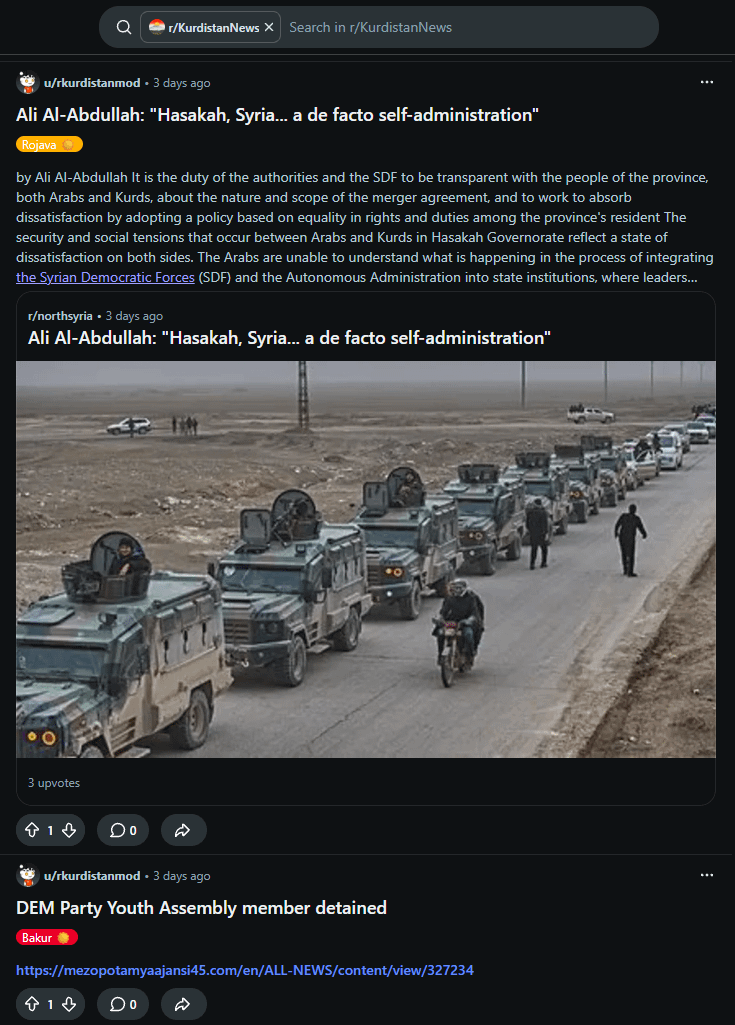
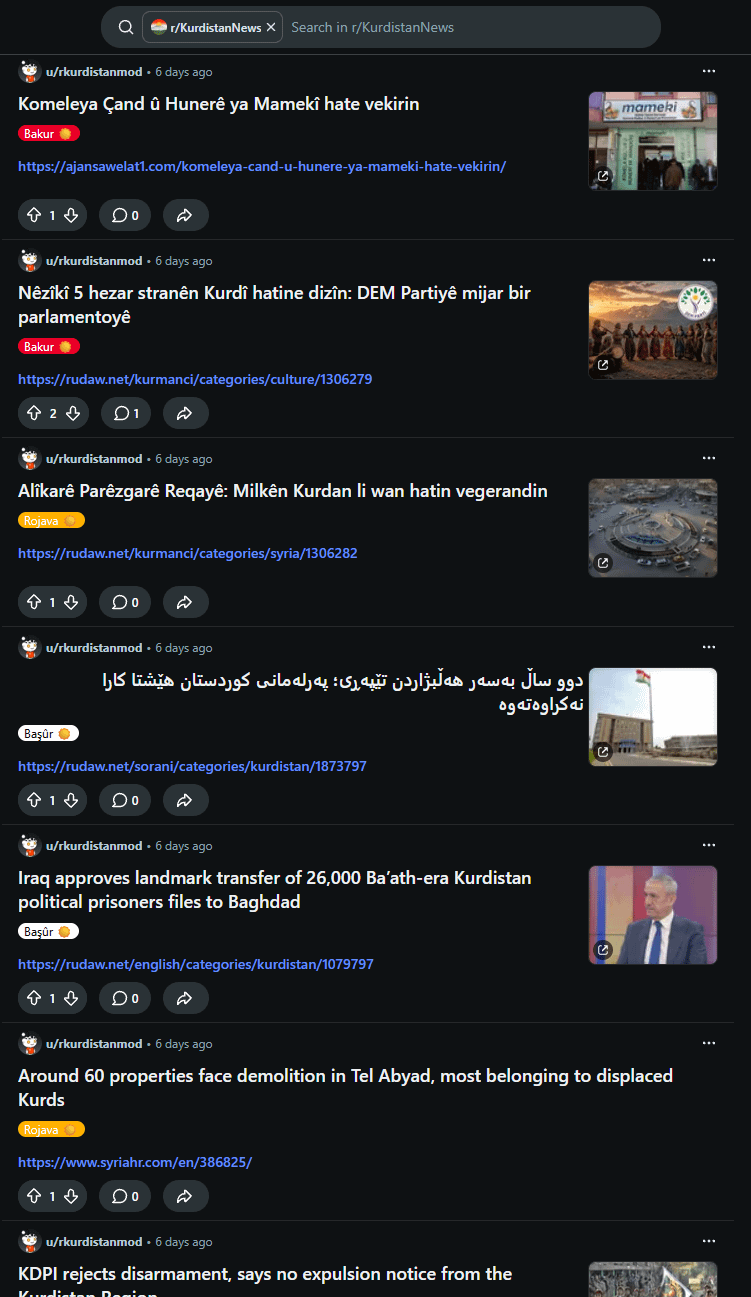
The digest posts

What we found

For the week of the experiment (7–13 October):

Views went down, not up: 70.9k views, about 6,000 fewer than the previous week.

Discussion didn't grow: 129 published posts (+6) and 1.1k published comments (+85), essentially flat. The same number of discussion-type posts appeared, with similar quality in both the posts and the comments.

The digests themselves got very little engagement. Few people opened them, and fewer commented.

The news people cared about still won. Even with far less news being posted, the highest-engagement posts of the week were still some of the standalone news posts we did allow. Removing most news from the front page didn't free up space for more conversation. It just buried the news. Normally at least some articles rise to the top and spark real discussion; inside a digest, none of them could.

One example would be "Kurds, Arabs want to reverse ‘Arab Belt’ in Syria" article. It was included in the Kurdistan Daily Digest – 15 October 2026. That digest received 753 views, 3 upvotes and no comments with the majority of the views from United States 21.3%, Germany 16% and Sweden 13.1%. One hour after the digest was posted, another user reposted the article as standalone as a series of images (that are hosted on reddit) with a link to the article. The standalone version received 1.6K views, 13 upvotes, 17 comments with the majority of the views from Iraq 18.4%, United States 16.5%, Germany 14.9%. Same article in both the digest and standalone, the digest posted an hour before. The standalone article was twice as popular as the entire digest.

By using the digest format, we are fighting against reddit's intentional design as a social news aggregator, against reddit's own recommendation algorithm, against our own subscribers observed behavior and preferences.

The part that bothered us most

The digests were also where most of the Sorani and Kurmanji content ended up. By restricting Kurdish-language news to the digest, we effectively buried Kurdish-language posts on a Kurdish subreddit. That's the opposite of what we want. Increasing our Kurdish-language coverage also increased our % of viewers with a country designation of Iraq (which we assume are mostly Kurds living in KRG).

What happens next

We will be discontinuing the Daily News Roundup / Digest format. We may reduce the overall number of articles we post, so the feed stays balanced. We remain committed to seeing more Kurdish (Sorani, Kurmanji, and other dialects) posted here, and we won't use any format that pushes it out of sight. Thank you to everyone who raised the concern and to everyone who gave the digest a fair shot. We took the suggestion seriously, tested it, and the numbers gave a clear answer.

If you want to see more discussion here, the best way to make that happen is to start one. Text posts, questions, culture, language, history, personal experiences: all welcome, and they'll get room on the feed.

As always, feedback is welcome in the comments.

— The r/kurdistan mod team


r/kurdistan • • 24d ago

Social Media Follow the custom feed of Kurdish subreddits on Reddit

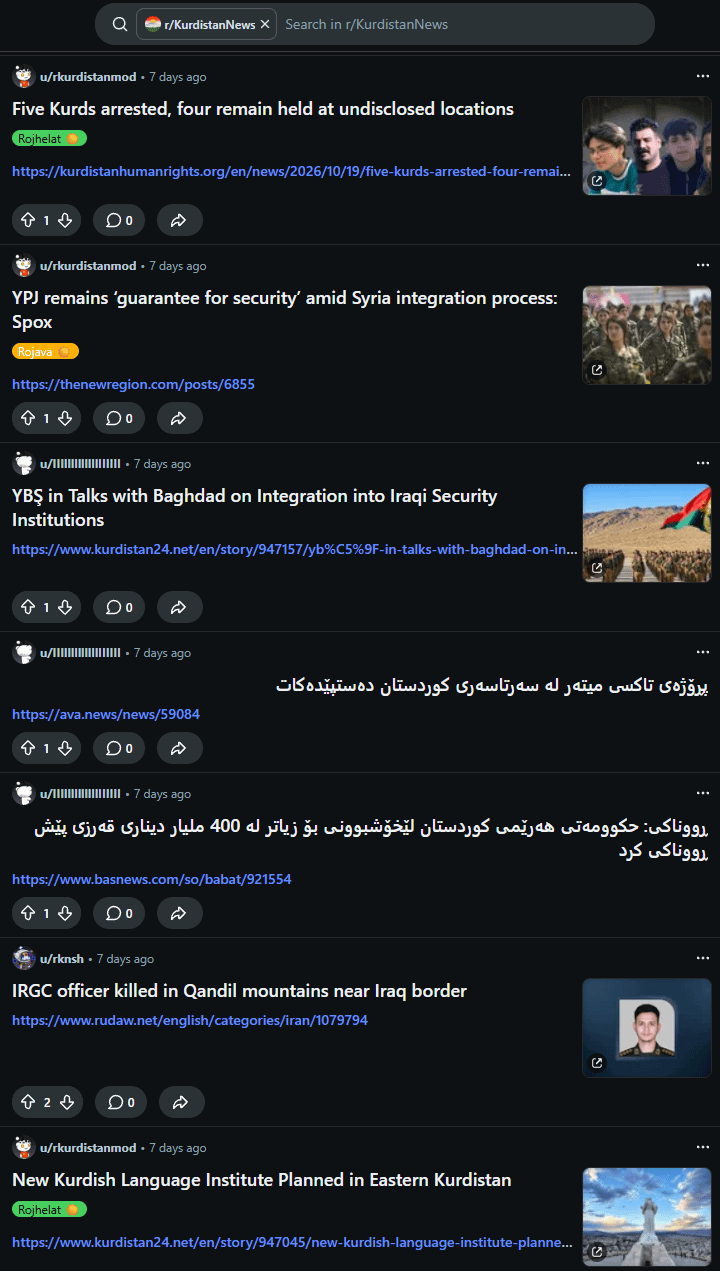
Post image
7 Upvotes
  • You can follow the custom feed (which will work as long as my account exists) or duplicate it and have it under your own account.
  • Currently there are 76 subreddits in the custom feed.

https://www.reddit.com/user/rknsh/m/kurdistan/new/


r/kurdistan • • 39m ago

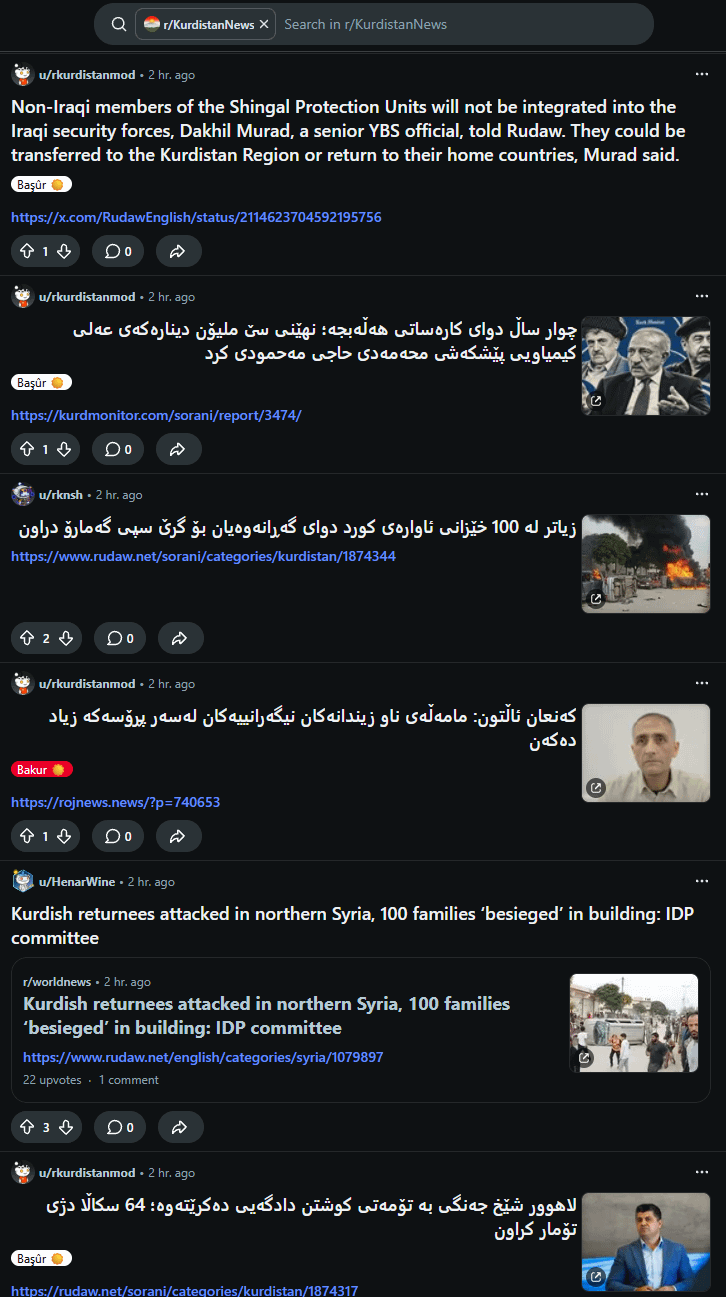
Rojava 69 vehicles burned and around 100 Kurdish families attacked while returning home to Girê Spî, occupied by Turkey in 2019, after years of forced displacement. The attacks were carried out by Arab settlers and former members of ISIS, backed by Turkey, and in full view of the Damascus government.

• Upvotes

r/kurdistan • • 6h ago

Opinion 🔥 The Kurdistan (KRG)education system is horrible

11 Upvotes

The Kurdistan education system is an absolute nightmare, and Wizari is broken beyond repair like tbh I just need to get this off my brain because the state of education here is absolute shit, and nobody in power seems to care at all. Calling it a learning environment is a joke.

First of all, the whole system is pure rote memorization. Wizari Grade 12 isn't testing intelligence or critical thinking, it’s literally testing how well you can act like a copy-paste machine. The first-time pass rate sits at a tragic 25 to 35 percent every year, which doesn't even meet standards and is insanely bad but not because of the students themselves. If you don't cram every single footnote and line, you're done for ngl. Plus you also have 12 years of school but all the internal exams are completely useless and the only thing that ever matters actually is a random high stake exam that determines your whole future. Literally that paper.

There's Arabic as well which everyone complains about. We’re expected to score good marks on random Arabic grammar and literature, but the way it’s taught is useless. Most students finish 12th grade unable to hold a basic 2 minute conversation in Arabic, yet Wizari hits us with hyper-specific grammar rules that just drag everyone's average down for no reason. But the thing is we never should remove Arabic as a subject, but rather make it actually useful and stop relying on traditional fusha grammar/literature and make Arabic an useful subject that isnt hated.

Thing is tho you can’t even blame the teachers either because the ministry fails to pay them on time for months. This results in massive strikes, especially in places like Sulaymaniyah and Halabja. Schools shut down for weeks, and when they finally reopen, teachers have to rush through half of manhaj in a few days. Students end up having to self teach massive chunks of the curriculum right before exams.

On top of that, so many schools operate on double or even triple shifts because of terrible infrastructure. Two or three different schools share one building, so class periods get cut down to 30 minutes. How are you supposed to learn complex subjects when your whole school day lasts barely 3 hours in a packed building?

Because public school is so stripped down, Grade 12 has turned into a p2w business. If your family can’t afford millions of dinars for private institute tutors or institution courses, your chances of getting into a good university department drop to almost zero literally. Public classrooms are basically just attendance stations at this point.

To make it worse, every year the exam committees include obscure or darki (external) questions just to lower grades, leading to protests after every single exam cycle. The system doesn't educate anyone, it just stresses students out and filters them out from any future.

The government only wills to help private schools expand for the money. You basically have to pay just to get a better education system that is the basics for most of the world.

Unfortunately the reason why all of this is happening is primarily due to corruption sadly, and also hard legacy curriculum and insane exams. Other global systems are advancing, while here is absolute shit. I know a lot of other education systems are like this but here it is just crazy.

We should demand reforms and get a major education system change, but it's not going to happen sadly it's just going to stay like this forever. Don't worry it won't get better. But inshallah something soon will happen.

Thanks for reading.


r/kurdistan • • 5h ago

Kurdish خوێندکارانی دێرک بۆ پشتگیری لە زمانی کوردی گردبوونەوە

Thumbnail
rojnews.news
4 Upvotes

Students in Dêrik rallied again for Kurdish-language schooling. They reject a decision allowing only three Kurdish lessons a week and demand full mother-tongue education.


r/kurdistan • • 20h ago

Rojava Arabs Attack Displaced Kurdish Families Returning to Tell Abyad (Girê Spî) While Shouting “Allahu Akbar”

71 Upvotes

Another W for biratiya gelan.


r/kurdistan • • 5h ago

Kurdistan We do not deserve a country until we think like a country and act like a country

5 Upvotes

This so called integration and disarmament is setting Kurdistan back, leaving Kurdish civilians to suffer even more and struggle.

Why i say we need to think and act like a country, if our leaders do something wrong we must criticise them as a nation, and if a leader doesn’t serve Kurdistan any longer we must remove them as a nation, and choose a new leader to serve Kurdistan.


r/kurdistan • • 4h ago

Bashur Iraqi women seek refuge in Hewlêr from Ja’fari code

Thumbnail
theamargi.com
4 Upvotes

Hundreds of Iraqi women have sought refuge in Hewlêr/Erbil, fleeing domestic violence, child marriage, and family control amid concerns over Iraq’s amended Personal Status Law and the Ja’fari code.


r/kurdistan • • 5h ago

Kurdish Movies 🎬 Derhêner Nesrîn Ebdî: Ez dixwazim li ser Rojavayê Kurdistanê fîlmekî mezin çêbikim

Thumbnail
rudaw.net
3 Upvotes

After screening her ISIS-war documentary "Pêşwaziya Mirinê", director Nesrîn Ebdî says she is making a documentary on an Anfal survivor and plans a major film on Rojava.


r/kurdistan • • 8h ago

Bashur KRG criticizes Baghdad over Yazidi fighter integration in Shingal, warns of ISIS threat

Thumbnail
rudaw.net
7 Upvotes

Kurdistan Region Interior Minister Rebar Ahmed says Baghdad integrated about 2,000 YBŞ fighters without consulting Erbil, breaching the 2020 Shingal Agreement, and warns it will not bring stability.


r/kurdistan • • 6h ago

Bashur Deep Dive: As the PKK packs up, will Turkiye also leave KRG?

Thumbnail amwaj.media
5 Upvotes

The withdrawal in October of the Kurdistan Workers' Party (PKK) from Turkiye and border areas of the Kurdistan Regional Government has kickstarted a debate over Turkish bases in KRG. With the “armed threat” that Ankara has long cited as justification for its presence seemingly receding, the rationale will likely need reformulating as Turkiye's military engagement in Iraq comes under ever greater scrutiny.


r/kurdistan • • 7h ago

Bashur clean hawler/erbil

3 Upvotes

we should make a community to clean hawler monthly each place a time, the starting will be rough it always will be, but we gotta take actions since erbil is actually is getting really dirty. if ur interested in either supporting or volunteering dm me.


r/kurdistan • • 32m ago

Rojava US condemns violence against Kurdish IDPs in Syria, demands accountability: State Department

Thumbnail
rudaw.net
• Upvotes

ERBIL, Kurdistan Region - Washington condemns the incident in Gri Spi (Tel Abyad) north of Syria in which displaced Kurdish families faced violence from rioters following attempts to return after seven years of displacement, an official from the US State Department told Rudaw late Tuesday, while calling on Damascus to hold the perpetrators accountable. 

“Syrians displaced by years of conflict must be able to return home safely and voluntarily, free from violence and intimidation,” a spokesperson from the US Department told Rudaw’s Diyar Kurda through email.

“The Syrian government must hold all perpetrators of violence accountable and ensure the security of all Syrians, including returning families,” he stated.

His statement comes as a group of internally-displaced persons (IDP) from Gri Spi on Monday returned with their title deeds, hoping to retrieve the properties they left behind after a Turkish-led offensive in 2019 that forced an exodus of Kurdish residents. 

Their return was met with immediate violence and vandalism from rioters. 

One of the survivors of the incident told Rudaw earlier on Tuesday that “around 70 to 80” vehicles suffered damages. Videos circulating on social media also showed rioters overturning cars and setting them on fire. 

He recounted rioters chanting “Allahu Akbar” as they approached the convoys, heaping insults and stating “you are pigs.”

More than 200 IDPs were trapped in a building for nearly nine hours before security forces arrived at the scene. 

The attack marks the second incident of this magnitude that Kurdish IDPs have been subjected to. A convoy carrying a batch of Kurdish IDPs displaced from Sare Kane (Ras al-Ayn), east of Gri Spi, was attacked by settlers and rioters in August. Sare Kane also experienced an exodus of Kurdish residents following the 2019 Turkish offensive.

Reiterating support for “a unified, sovereign Syria,” the US official said “Kurds and all other communities” must be able to “enjoy equal citizenship, security, and meaningful participation in governance” in the country. 

He also urged the Syrian government and local authorities to “uphold their commitments, address legitimate concerns, and take practical steps to rebuild trust between communities.”


r/kurdistan • • 35m ago

News/Article Kurdistan’s Liberty: A Consequence of Its Pre-State Condition?

Thumbnail mises.org
• Upvotes

In the classical liberal tradition, and particularly in the thought of Ludwig von Mises and Murray N. Rothbard, the concepts of the nation and the state are neither identical nor necessarily inseparable. The existence of a national and cultural community does not logically require the establishment of a centralized state possessing a territorial monopoly of political authority. Mises, through his emphasis on the principle of self-determination, and Rothbard, through his defense of secession and his critique of the concentration of political power, opened the possibility of smaller and more decentralized political arrangements as alternatives to large and centralized states. From this perspective, the fundamental issue is not simply whether a state exists, but rather the extent to which political power is concentrated and possesses the capacity to exercise a comprehensive monopoly of coercion.

The political history of Kurdistan provides an illuminating case through which to examine this question. The historical division of Kurdistan among several states and the absence of a unified Kurdish state have generally been regarded within Kurdish nationalism as a historical tragedy resulting from successive political defeats. Yet this condition has also prevented the emergence of a single centralized political authority over the entire region. In Iraqi Kurdistan, moreover, the rivalry between the principal centers of political power, particularly Erbil and Sulaymaniyah, has produced a degree of institutional and political fragmentation. This condition should not be interpreted as equivalent to libertarian freedom. Nevertheless, it may constrain the ability of any single political authority to impose uniform and comprehensive controls over political and economic life.

From a Misesian and Rothbardian perspective, this raises an important question: Can the absence of a unified and centralized state, under certain conditions, create greater space for political pluralism, institutional competition, and constraints on state power? The purpose of this essay is not to argue that a weak state is inherently equivalent to liberty, but rather to examine whether the fragmentation of political authority can function as one of the conditions that limits the concentration of coercive power and thereby creates space for individual liberty and voluntary exchange.

Accordingly, Iraqi Kurdistan can be examined as a case through which to explore the relationship among nationhood, state formation, political decentralization, and economic and individual liberty. The central argument is therefore not that Kurdistan’s historical statelessness has itself produced liberty, but that the absence of a unified political authority may, under certain circumstances, have constrained the concentration of power and thereby allowed forms of political, institutional, and economic pluralism to emerge.

Kurdistan is a region in the Middle East that has historically been divided among Iran, Turkey, Iraq, and Syria. Kurds have often seen this division as the result of their historical defeats by neighboring states. For this reason, Kurdish political movements have repeatedly tried to change this situation by opposing the central governments that rule different parts of Kurdistan.

But the Iraqi part of Kurdistan has followed a somewhat different path. After decades of conflict with Baghdad, especially following the Gulf War and the establishment of an autonomous administration in the 1990s, Iraqi Kurdistan gradually developed its own political and economic environment. The Kurdistan Regional Government (KRG) was later recognized constitutionally as a federal region of Iraq.

At the same time, several Kurdish opposition groups from other parts of Kurdistan have established themselves in Iraqi Kurdistan. Many of them still have ambitions to return to their own territories and continue their struggle against the central governments there. They all use nationalism to some extent to describe their goals, but they are far from being united. In fact, some of them have political ideas that are completely opposed to one another. 

The political and economic situation in the Kurdistan Region is also somewhat different from the rest of Iraq. There is relatively more room for private business, and at certain times and in certain areas there has been more space for journalists and political actors. Trade is also relatively open, and in some areas the barriers to doing business are lower than one might expect in a region with such political instability. 

There are even some strange examples of this situation in everyday life. In parts of Sulaymaniyah, for example, conflicts between residents and municipal authorities over construction and demolition decisions have sometimes turned into armed resistance. I am not suggesting that this is something desirable or that violence should be celebrated. But it does show something interesting: when government authority is weak, people sometimes have more room to resist government decisions.

A large part of this situation comes from the weakness of the KRG itself and, perhaps more importantly, from the rivalry between its two main political centers, Erbil and Sulaymaniyah.

The long-standing rivalry between the Kurdistan Democratic Party (KDP) and the Patriotic Union of Kurdistan (PUK) has created a fragmented political structure. They have their own political institutions, security forces, economic networks, and areas of influence. As a result, the KRG has never had completely uniform control over the whole region.

This political fragmentation has also affected the economy. In Kurdistan, people can use several currencies in everyday transactions: the Iraqi dinar, US dollar, euro, Iranian rial, and Turkish lira. Also, it’s not a competing monetary institution, but as currency circulation it means de facto currency pluralism. Money changers are everywhere, and people can move between currencies relatively easily. This may look like a simple economic detail, but I think it has a deeper political meaning.

Because there is no independent Kurdish currency, Kurdish authorities do not have the same monetary power that a normal sovereign state would have. They cannot simply create a national currency and use monetary policy as another instrument of political control. 

There have been discussions among Kurdish intellectuals and politicians about creating a Kurdish currency. But so far, this has not happened. From a libertarian perspective, this situation is quite interesting.

Kurdistan does not have a fully sovereign state, and therefore its political authorities do not possess all the tools normally available to a centralized government: a national currency under complete state control, a unified monetary policy, fully standardized taxation, or complete control over borders and trade.

Of course, this does not mean that Kurdistan is a free-market paradise. It is not. The KRG has taxes, customs duties, regulations, public monopolies, political patronage, and powerful political parties with considerable influence over the economy.

But something unusual has happened because political power is fragmented: Different currencies circulate, different political authorities compete, local institutions have different levels of power, trade networks cross political boundaries, and no single authority can always impose the same rules everywhere.

This brings me to an interesting question from a Misesian or Rothbardian perspective: Can the absence of a strong centralized state unintentionally create conditions that are more favorable to economic freedom? Kurdistan may be an interesting case for exploring this question. 

The historical division of Kurdistan among neighboring states prevented the formation of a single centralized Kurdish state. Later, the political division within Iraqi Kurdistan, especially the rivalry between Erbil and Sulaymaniyah, made it even more difficult to create a completely unified regional authority. The absence of a unified Kurdish state has historically produced fragmented political authority; although this fragmentation has not necessarily produced liberal institutions, it may have constrained the capacity of any single authority to impose uniform political, monetary, and economic controls, thereby creating spaces of de facto pluralism that a centralized state might eliminate.

There is therefore a strange paradox here. What Kurdish nationalists have traditionally considered one of the greatest tragedies and weaknesses of Kurdish history, the absence of a unified Kurdish state, may also have created some of the conditions for political and economic pluralism.

This leads to a bigger question: What would happen if Kurdistan eventually became a unified and fully sovereign state? Would independence strengthen Kurdish political power but at the same time reduce the economic and political pluralism that developed partly because no single authority was strong enough to control everything? Or could Kurdistan build a different kind of state, one based on federalism, decentralization, competing jurisdictions, monetary pluralism, free trade, and strong protection of individual rights?

For me, the future of Kurdistan is therefore not only about whether Kurds will have a state. It is also about what kind of state that would be. Perhaps Kurdistan does not have to choose between nationalism and liberty. It could try to transform its historical political fragmentation into a system of decentralized liberty.

There is an irony here. The very condition that Kurdish nationalism has traditionally seen as a historical tragedy, the absence of a unified Kurdish state, may also contain the beginnings of an alternative political order. Although the historical absence of a unified Kurdish state should not be romanticized as a source of freedom. Yet neither should it be understood exclusively as a political tragedy. Fragmented authority has sometimes limited the capacity of a single government to monopolize political and economic life. The libertarian challenge is therefore not merely to establish Kurdish sovereignty, but to prevent sovereignty itself from becoming excessively centralized.

r/kurdistan • • 1h ago

Ask Kurds 🤔 Chill Date Spots in Kirkuk?

• Upvotes

Hi there, basically the title

Looking for leftist/chill themed place that is suitable for dates in Kirkuk


r/kurdistan • • 5h ago

Opinion 🔥 Integration Could Make the PKK’s Regional Network Stronger

Thumbnail
thenationalcontext.com
0 Upvotes

"The PKK’s regional integration in Syria and Iraq, alongside its peace process with Turkey, points to a two-layered arrangement. At the national level, its affiliated groups are giving up part of their separate organisational identities by integrating into the states in which they operate. In return, they gain recognition and potentially substantial influence in their local areas, creating a form of indirect decentralisation. At the regional level, they remain part of a single network that recognises the imprisoned PKK founder Abdullah Ocalan as its leader. In some ways this arrangement has no precedent in the century since the partition of the Ottoman Empire. Kurdish rebellions and movements in these countries have since had their own local leadership and organisational structures. The PKK’s network is following a different model, in which its affiliates give up some of their autonomy through integration while potentially becoming legally recognised entities within their respective states."


r/kurdistan • • 18h ago

Discussion What language did the ancestors of modern Kurdish people speak in ancient times?

9 Upvotes

To be honest, I unfortunately don’t really know much about the history of my own ancestry. Im trying to learn what language did Kurdish Kurmanji to be more precise used to speak.

When we look at history, we know that different civilisations and peoples spoke different languages. The Romans spoke Latin, people in ancient Britain spoke Celtic languages, and the Aztecs spoke Nahuatl.
This made me curious about the ancestors of modern Kurdish people. What languages did they speak in ancient times, and how did those languages eventually develop into Kurdish?


r/kurdistan • • 7h ago

Kurdistan Hiking in mountains in Sulaymaniyah

1 Upvotes

Hello, I would like to go for mountains hiking in Sulaymaniyah and the around area, do you know any travel agency or a groups that do these kind of activities ?


r/kurdistan • • 1d ago

History Jash of the day: Diyab Axa / Diyap Yildirim

Thumbnail
gallery
45 Upvotes

• He was from Alawite Ferhadan tribe of Zazas/Kirmancs of Dersîm.

• He was an officer in Ottoman (Kurdish) Hamidiye Corps and fought with Russians to take Bedlîs and Sêrt and he met Mustafa Kemal there.

• He had good relations with M. Kemal so he was selected representer of Dersîm with the help of another Kurd, Xeyrî Kanko.

• He was a fierce supporter and defender of Turkish government and and stated that "Turkey is the only representer of the Kurds".

• While Turkey and Greece were in war and some of the Turkish deputies were talking about moving the parliament to another city, he infamously refused and strongly opposed the idea and said: "Even if I am alone, I will fight to my last bullet for my flag, religion, and homeland. I'll shoot the last bullet in my head."

• He often used Islamism to counter Secularism of Kemalism even he was a member of Kemalist Government.

• He was against to his own people's rebellions such as, Dersîm, Qoçgirî and Şêx Seîd. He labeled Şêx Seîd as "traitor", "enemy" and "rebel".

• Even so, when he asked to M. Kemal to keep the Dersîm's name same and no change after Dersîm Rebbellion, M. Kemal changed the name although Diyab was very loyal against everything.

• He had an monthly salary decided by M. Kemal after his deputyship ended and he go back to the Dersîm and lived there till end of his life.


r/kurdistan • • 1d ago

Rojava Displaced residents attempting to return to their homes in Serekaniye were ambushed and physical violence was inflicted upon them by local Arab settlers, resulting in severe injuries and the destruction of several civilian vehicles.

Post image
41 Upvotes

.

https://reddit.com/link/1xfuwpc/video/5oyadvx1xsxh1/player

https://reddit.com/link/1xfuwpc/video/tn46o0o2xsxh1/player

Serekaniye came under the control of the Turkish Armed Forces and affiliated Syrian National Army (SNA) mercenaries following Operation Peace Spring in October 2019.

The 2019 offensive displaced over 150,000 to 200,000 original residents, predominantly ethnic Kurds.

In the aftermath, Turkish-backed mercenaries facilitated the settlement of Arab settlers from other regions of Syria into the vacated homes left behind by Kurdish residents.


r/kurdistan • • 1d ago

Ask Kurds 🤔 When will Kurds start caring about the environment?

6 Upvotes

I've noticed that environmental issues don't seem to be a priority for many people in Kurdistan, and honestly, I find it frustrating.

The air is so polluted that sometimes it feels difficult to breathe properly. People often complain about pollution in major European cities, but compared to what we experience in Kurdish cities, many of them seem incredibly clean. If you check the Air Quality Index (AQI), some European cities have readings of around 3, while in Kurdistan, its often 9 or 10.

Between vehicle emissions from low-quality fuel, the burning of oil and other fuels, and the open burning of garbage, the air can become incredibly polluted. On top of that, there is excessive plastic use everywhere. Plastic bags and bottles are used in enormous quantities, often for convenience, and much of this waste ends up littering the streets or being burned instead of being properly collected and recycled. Yet, this barely seems to be treated as a priority.

Why aren't we doing more to address this? Why aren't we enforcing better fuel quality standards, investing in reliable public transportation, stop burning garbage, and introducing proper waste management and recycling systems?

These things directly affect our health and quality of life. Clean air and a healthy environment should be basic necessities, not luxuries.

What frustrates me is that we often seem to associate development and progress with fancy apartments, modern buildings, luxury cafés, and expensive restaurants. But what is the point of building beautiful cities if the air is polluted and the environment is neglected?

Real development should also mean being able to breathe clean air, walk around without inhaling smoke, and live in a city where the environment and people's health are taken seriously.

Why do you think environmental awareness and pollution control aren't bigger priorities in Kurdistan? Is it a lack of public awareness, government accountability, infrastructure, or something else?


r/kurdistan • • 1d ago

Bashur YBŞ spokesperson Hadi Elyas announced that, as part of the integration into the Iraqi security forces, 2,500 YBŞ-YJŞ fighters will be included in the first phase, followed by another 1,700 in the second phase. Elyas stated that a total of 4,200 fighters are expected to be integrated.

11 Upvotes

r/kurdistan • • 1d ago

News/Article Want more news about Kurds and Kurdistan? Join r/KurdistanNews

5 Upvotes

Don't miss a story, join Kurdistan News


r/kurdistan • • 1d ago

On This Day Peshmerga Commanders Recall 2017 Sihela Battle Nine Years On

Thumbnail
kurdistan24.net
6 Upvotes

Kurdistan Peshmerga commanders marked the ninth anniversary of the Battle of Sihela on Monday, Oct. 26, recalling how Kurdish forces resisted an advance by Iraqi troops and Popular Mobilization Forces (PMF) fighters during the armed confrontations of October 2017. The fighting took place on Oct. 26, 2017, when Iraqi forces and PMF fighters launched an attack on Peshmerga positions along the Sihela front.


r/kurdistan • • 1d ago

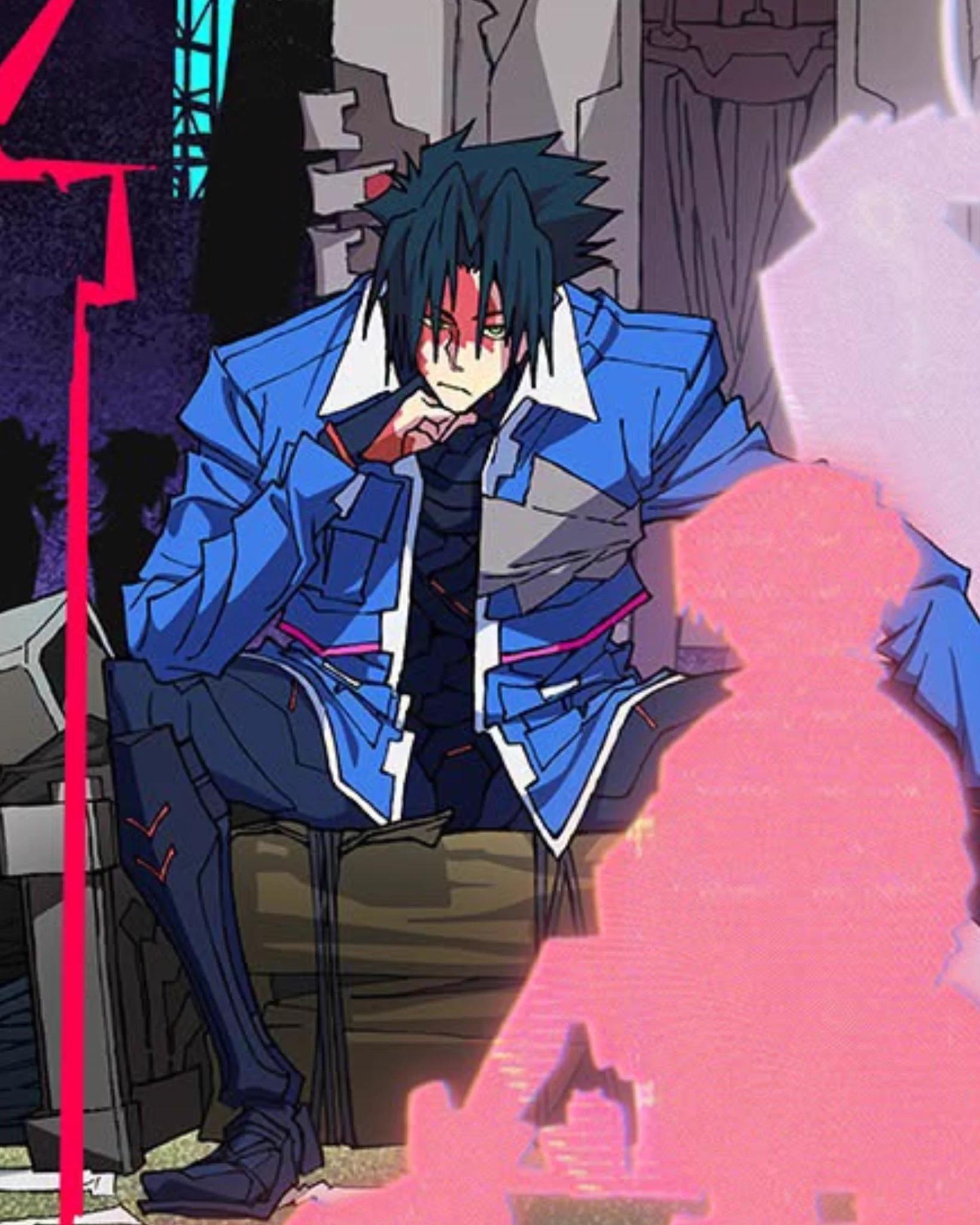
Anime and Fiction D from Cyberpunk Edgerunners 2 most likely lightly inspired by Kurds

Post image
36 Upvotes

was thinking this after I heard a Kurdish song in the show about him, he's also a nomad whose whole tribe got killed. just listening to the lyrics of the song makes me think it might actually be the case, why else would they use a Kurdish song to tell his story? and I don't think it's too far fetched either since there have been a few other Kurds in Japanese media (Sniper Wolf from Metal Gear Solid, Soran Ibrahim from Mobile Suit Gundam 00 and Rebel Sword/Kurd no Hoshi - a whole manga about Kurds). Some of the people who have seen the show might agree with me but I'm curious to hear what the rest of you think. Here's also a link to the song for those wondering about the lyrics, it's in Sorani https://www.youtube.com/watch?v=MknuxFZBYmk