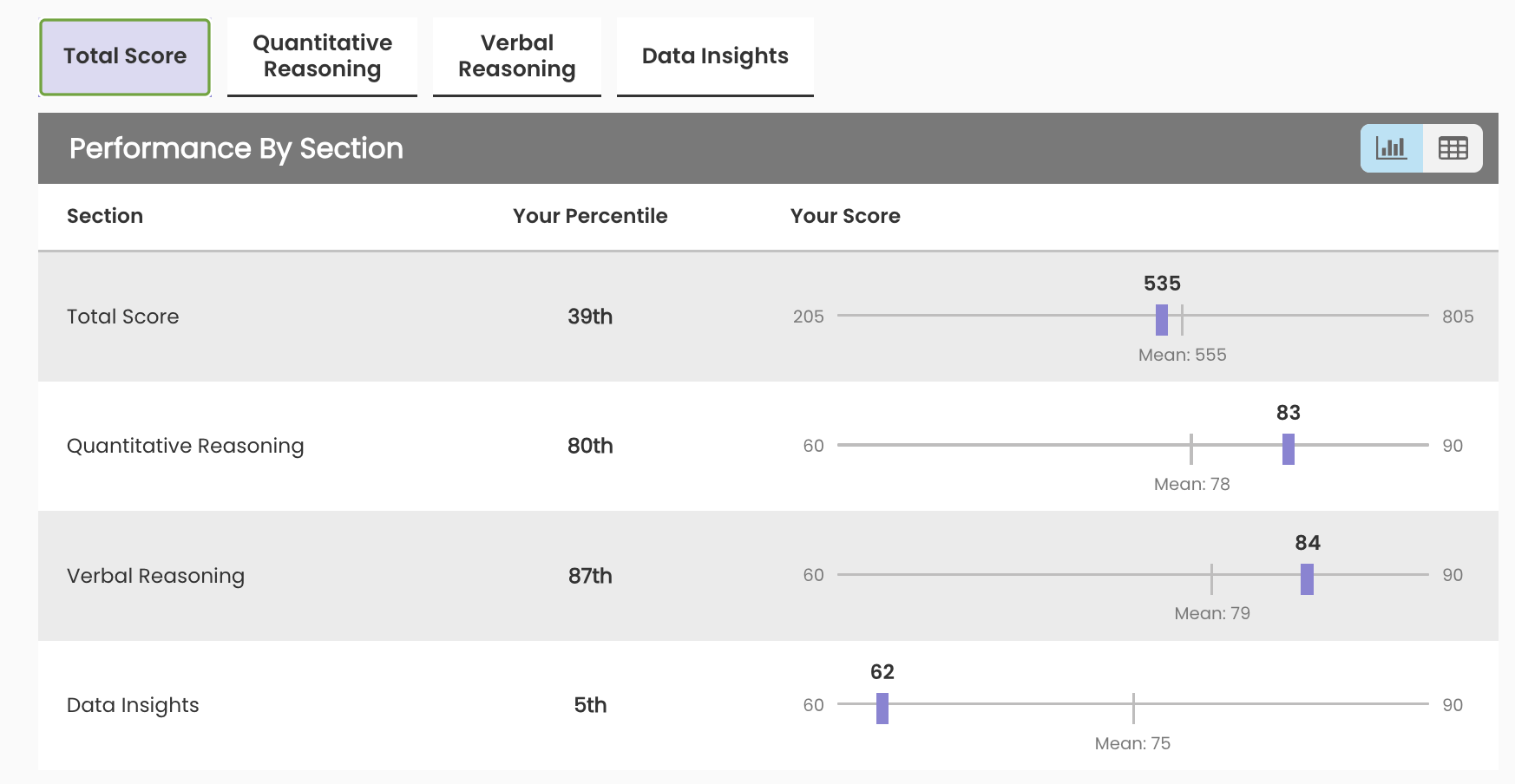
Just took the GMAT and finished at a 715 (V84, Q90, DI82), first attempt. Writing up what actually worked, since my prep was on and off over about a year and some of it might help someone who's strong in one section and stuck in another.
Quick background. Quant was always my comfortable side and verbal was a mess. My first full mock last November came in somewhere in the mid 630s, with verbal clearly the problem and Data Insights a coin flip depending on the day. I started with the official books, but they didn't really lay out step-by-step ways to attack a question, and that's how I learn best. So I moved to prep materials that did, and worked through the verbal and DI lessons from January to May, fitting it around work. I didn't revisit quant content much because my fundamentals were already there.
Quant (swinging in the 80s, then a 90)
I didn't keep an error log for quant because it was my best section. Big mistake. My timed quant sections started bouncing anywhere between 80 and 90 and I couldn't tell why. Eventually I sat down, went back through several sections at once, and wrote down every question I'd missed. Wait a second, five questions of the same type, all wrong because of the same wording. Prime number questions and range questions where I'd skip past a small word kept showing up, and "must be true" questions were in there four separate times.
Once I saw that, I slowed down on those phrasings and did extra targeted practice on those types. The swings stopped and I got a 90 on test day. The annoying part is that if I'd logged after every section instead of in one big batch, I'd have made far fewer repeat mistakes.
What my error log ended up looking like, because this changed everything for me:
- A failure type for each miss instead of writing "silly error." I had someone more experienced go through my log with me early on, and a lot of my "silly" mistakes turned out to have an actual pattern.
- Short entries. Mine got so long I stopped reading it, so I collapsed it into the failure type and what I'd do differently next time.
- A confidence column. I marked how sure I felt on each question. In quant I was usually sure and still wrong, which meant small fixes. In verbal I was unsure on almost everything, and that told me where the real work was.
Data Insights
DI ended up fine but it took some fixing. Data sufficiency was hit or miss because my process could get too long. Two-part analysis had a lot of reading up front, but at some point I realized those questions aren't trying to trick you the way verbal does. So I'd skim, then either write equations if it was quant-flavored or run the same negation approach I used in CR if it was verbal-flavored. Verbal-type DI questions I used to guess on started coming fairly quickly once CR clicked.
After that it was mostly a timing problem. What helped:
- Graphs and tables were naturally fast for me, so I let those buy time for the slower stuff.
- Multi-source reasoning was the killer. In some mocks one set ate eight or nine minutes and I rushed everything after it. I capped it at roughly six minutes, then bookmarked and moved on.
- On test day I was unsure on two of the three MSR questions, bookmarked them, finished the rest, and came back with a few minutes to change my answers.
Critical Reasoning
CR was my lowest area for the longest time. I'd read the argument half paying attention, go straight to the answers, and pick whatever felt right. When it came down to two choices I picked the wrong one a lot, mostly out of doubt. Doing the lessons helped a bit, but nothing in my education had asked me to think like this, so I just did a lot of official-style practice questions with explanations.
The switch was realizing CR is basically a quant problem written in words. Before checking the options I'd figure out what I was looking for, meaning the conclusion and what it rests on, then think about how I'd negate it. Suddenly it felt like math, which I'm comfortable with. Assumption questions took me the longest. Patterns from older questions helped, but applying an old pattern in a rush often got me burned by one word, so reading carefully and sticking to the process mattered more than speed. Verbal went from the mid 70s in May to 84 on test day.
Section order
Quant, then verbal, then the break, then DI. I used the same order from my very first mock and never changed it. Starting with quant warmed me up and gave me confidence for verbal. By the time DI came around I'd already done a mix of both kinds of thinking.
Mock tests
My full mocks went roughly mid 630s, mid 670s, mid 680s, low 720s, then 715 on the real thing. There are only six official mocks, so I saved them and did timed sections back to back in between. After every mock I redid the error log and drilled whatever was failing. From May on I did a full mock about every two weeks.
About a week out, after doing sections every single day, my CR dipped and I kind of panicked. I hadn't even booked the test. Instead of cramming, I took two or three days completely off, saw friends, just worked. Did one last mock four or five days before, then took the final two to three days off. The only thing I looked at was my error log, lightly, on the morning of the exam.
Wrap-up
There's no shortcut. Put in the hours, and review your mistakes so they don't happen twice. Test day itself felt like any other practice day once the online check-in bumps were sorted, and since it was my first attempt I wasn't chasing a number.
Happy to answer any questions.
This is my personal experience. Your mileage may vary.