r/ancientegypt • u/__Static___ • 24m ago
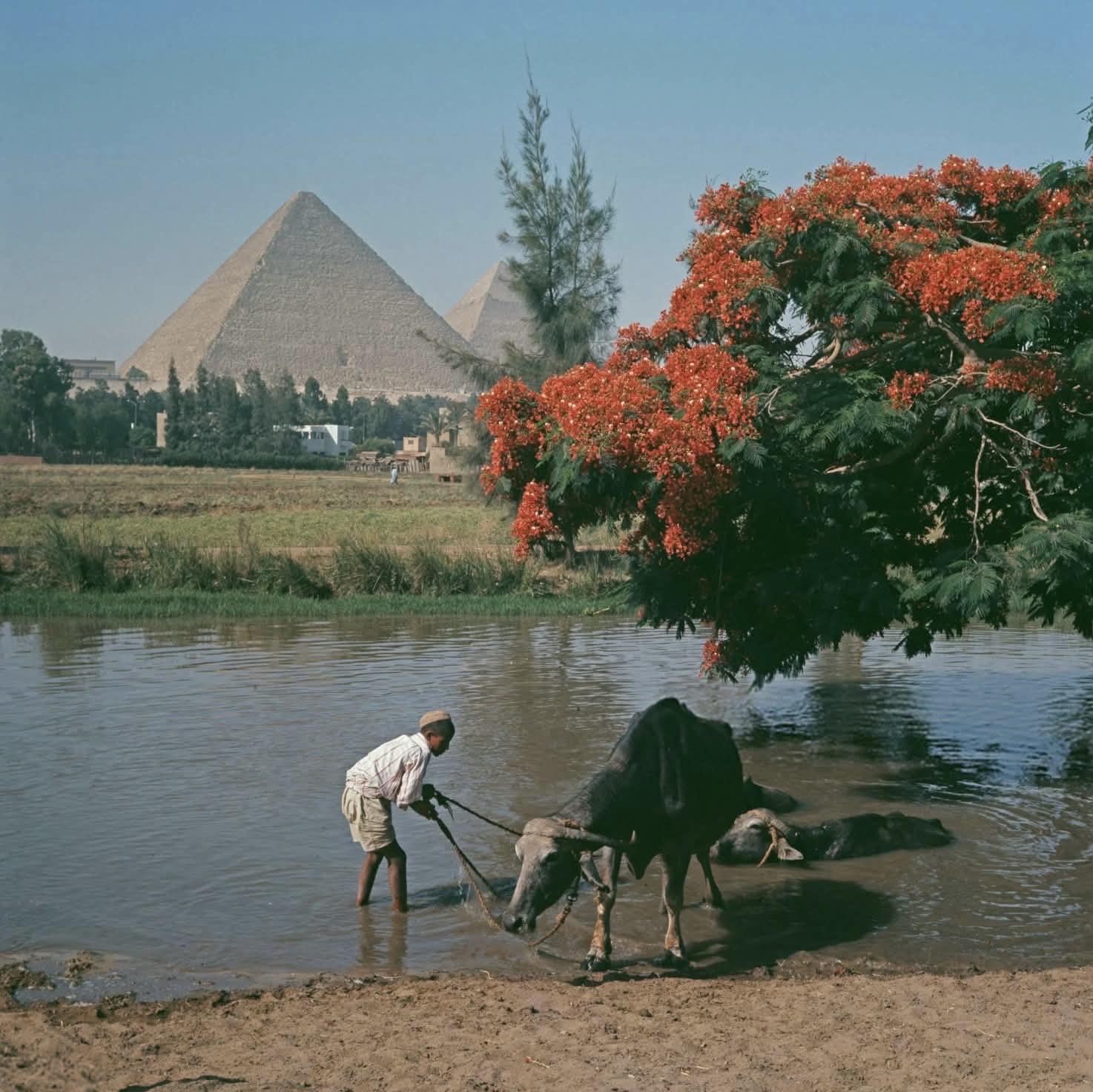
Photo Pyramids of Giza, photographed in 1962.
•
Upvotes
r/ancientegypt • u/TR3B-999 • 8h ago
Enable HLS to view with audio, or disable this notification
Taken between 1860 and 1900
r/ancientegypt • u/TR3B-999 • 3h ago
Enable HLS to view with audio, or disable this notification
(Not everything fit into the second part, so there will be three parts.)
r/ancientegypt • u/Handicapped-007 • 9h ago
Nespaneferher papyrus – Cairo 66
ns-pA-nfr-Hr
Ranke I, pg. 175, 5
Also known as Nespaneferhor, Nespahernefer, Nespaneferhor
Provenance Bab el Gasus, Daressy A.98, see Shabtis
God’s father of Amun-Ra, the king of the gods, God’s father of Mut, Overseer of the recruits of the domain of Amun
Son of a Serdjehuty who was also God’s father of Amun and Overseer of the recruits of the domain of Amun
See Contribution à l’étude de l’Amdouat, Sadek 1985, C8 Planche 15-16, for description see page 114-119.
Amduat papyrus for Nesypaneferher
Length 244 cm, height 23 cm
Ref. No. S.R.VII.10229, Cairo 66, Type A.II.1a Niwinski
Photo and panorama view VB 2021 (quality remark
Title
Nespaneferher papyrus – Cairo 66, Third Intermediate Period 21st Dynasty, 1076–944 BC, Findspot Deir el-Bahri, Papyrus and inks,
Ushabtis.com
https://www.ushabtis.com/papyrus%20nespaneferher/
Usabtis.com
r/ancientegypt • u/TR3B-999 • 2h ago
Enable HLS to view with audio, or disable this notification
(Here is the last part of the video Egypt 1860- 1900.)
r/ancientegypt • u/TR3B-999 • 1d ago
This is what Tutankhamun’s tomb looked like in 1922 when it was discovered.
In 1922, Howard Carter and his team opened the entrance to the tomb.
r/ancientegypt • u/Handicapped-007 • 43m ago
Shabti of Nespaheran, Egyptian priest
Production date
1069 BCE-945 BCE
Country
Egypt
Object detail
Description
Blue faience shabti of Nespaheran. Upright stance with wig, arms folded across the chest, and black inked headband, eyes, hoes and heighroglyphs on the front. Inscribed in black ink with "The Divine father of Amun, ouah-priest of Khonsu, and scribe of the temple of Amon"
Classification ARCHAEOLOGY Egyptian figure
Production date 1069 BCE-945 BCE
Production place Egypt
Measurements L105mm x W39mm x D30mm
Media/Materials description
Egyptian faience is a ceramic material with a siliceous body and brightly coloured glaze.
Faience (composed of quartz, alkaline salts [natron or plant ash], lime, and metallic mineral-based colorant)
Glaze (formed by alkali and lime reacting with silica to form the glaze)
Signature/Marks painted
History and use
A shabti is a mummiform figurine commonly found in Ancient Egyptian tombs. They were mass produced in the New Kingdom, where the shabti acted as a servant to the deceased, to perform the activities required in the afterlife, usually of an agricultural variety. The numbers placed in tombs increased dramatically in the New Kingdom, where the deceased would be provided with 401 shabtis: 265 workers (one per day of hte year) and 30 overseers.
Registration number E40129.1
Title
Shabti of Nespaheran, Egyptian priest, 1069 BCE-945 BCE, Findspot Egypt, Faience, Queensland Museum
https://collections.qm.qld.gov.au/objects/CH50131/shabti-of-nespaheran-egyptian-priest
Queensland Museum
r/ancientegypt • u/Substantial-Leg-9163 • 1d ago
Today seeing a photo of baal I noticed a frightening resemblance to The Hat of the Pharaoh of Upper Egypt the Hedjet Is there any correlation? Or am I just overthinking?
r/ancientegypt • u/Handicapped-007 • 1d ago
Foot covering from a mummy, with scorpions on soles
Ptolemaic Period–Roman Period
late 3rd century BCE–1st century CE
On view at The Met Fifth Avenue in Gallery 134
This is the footcase cartonnage of a small mummy. Cartonnage cases made of several individual pieces are characteristic of the period post 3rd century B.C. Mummies in gallery 133 have sets of this sort.
The footcase depicts the soles of two sandals with a scorpion crushed beneath each one. The imagery reflects the ancient Egyptians' desire to control the dangerous elements of their world, a concern that here is transferred to the world of the afterlife. On the mummy, the scene was intended to give power to the deceased over the inimical forces that he would encounter on his nightly journey through the netherworld to-ward rebirth each dawn.
Title: Foot covering from a mummy, with scorpions on soles
Period: Ptolemaic Period–Roman Period
Date: late 3rd century BCE–1st century CE
Geography: From Egypt
Medium: Wood, gesso, paint
Dimensions: H. 11.5 cm (4 1/2 in.); W. 11.1 cm (4 3/8 in.); D. 13.6 cm (5 3/8 in.)
Credit Line: Gift of Egypt Exploration Fund
Object Number: O.C.348
Curatorial Department: Egyptian Art
Provenance
Excavated by the Egypt Exploration Fund. Allotted to the EEF by the Egyptian Government in the division of finds. Given to the Museum by subscription at an unknown date before the establishment of the Egyptian Art Department in 1906.
References
Schreiber, Gábor 2011. "Early and Middle Ptolemaic Funerary Art at Thebes (ca. 306-88 B.C.)." In Proceedings of the Colloquium on Theban Archaeology at the Supreme Council of Antiquities November 5, 2009, for general dating, pp. 126-128, fig. 37.
Title
Foot covering from a mummy, with scorpions on soles, late 3rd century BCE–1st century Ptolemaic Period–Roman Period, Findspot unknown Egypt,Wood, gesso, paint, The Metropolitan Museum of Art
https://www.metmuseum.org/art/collection/search/552007
The Metropolitan Museum of Art
r/ancientegypt • u/Handicapped-007 • 22h ago
Death servant of Nespaneferher
Object Number
BSAe SSOM 0980
Cultural area
Egypt
Epoch
Third Intermediate Period
Basic information
Fayence, H. 11.6 cm, W. 4.2 cm, D. 2.5 cm
Inv. BSAe SSOM 0980
Provenance
Gift 2017 Swiss Orient Museum Foundation (1978–2017). As a loan since 2002 at the Antimenmuseum. 2002 gift from Dr. med. Märgen Stieger (1928–2010), Freiburg i.Br., to the Swiss Orient Museum Foundation. Formerly Wilhelm Dieudonné Stieler collection (1888–1912). Acquired during his Egyptian trip in 1908/9.
Description
The arms are crossed over the chest in the enveloping, the hands hold one painted hand comb. A three-part braided wig covers the head, two front curls fall onto the chest. The details of the face, eyes, eyebrows and mouth are highlighted by black. On the back of the figure is a rectangular, patterned backpack painted. In front there is a vertical inscription line: 'Illumination to Osiris, the father god of Amun, Nespaneferher'.
The figure is light blue, the inscription and painting in black
Nespaneferher was buried under the High Priest Pinodjem II in the necropolis of the Amun priesthood in Bab el-Gusus (Deir el-Bahari). The cache was discovered by Georges Daressy in 1891. 153 sarcophagi were found. The one of Nespaneferher received the number A.98 from the excavator. Two other sarcophagi, which were originally also made for Nespaneferher, are inscribed with his name and titles and have usurped members of the Amun priesthood.
The 153 sarcophagi and their grave goods are today scattered over many museums and collections, in part they were donated by the Egyptian government to friendly states, in part mainly smaller objects came into private collections (see the sarcophagus of Nespaneferher BSAe 1146). The sarcophagi ensemble of Nespaneferher is today in the Musée Georges Labit in Toulouse. With the sarcophagus and the mummy of Nespaneferher, his grave goods were also found, for example numerous small funerary figurines as well as the ushebti boxes. Between the mummy's legs, a papyrus was also discovered, inscribed and illustrated with excerpts from the Book of the Underworld "Amduat".
Bibliography
High-altitude flight and crash. Wilhelm Dieudonné Stieler (1888-1912). Egyptian traveler, collector and aviation pioneer. A catalog of the Foundation for a Swiss Orient Museum (Basel 2006), 80f.
Title
Death servant of Nespaneferher, Third Intermediate Period 21st Dynasty, 1076–944 BC, Findspot Deir el-Bahri, Faience, Antikenmuseum Basel
https://antikenmuseumbasel.zetcom.net/en/collection/?q=Nespaneferher
Antikenmuseum Basel
r/ancientegypt • u/ismaeil-de-paynes • 1d ago
I hope you like this post, my sincere regards from Egypt ...
----------------------------
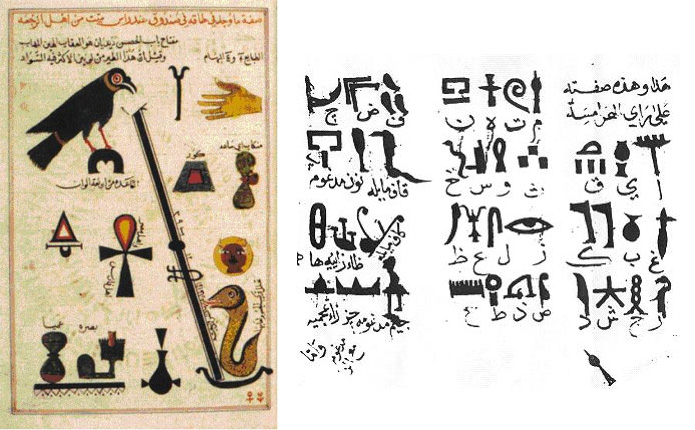
This list presents the pharaohs and queens of Ancient Egypt as preserved in medieval Arabian and Coptic literature. It is a composite of Manetho transmitted through Christian chronographers, Qur’anic and Biblical sacred history, Coptic folklore, and popular legend.
It reflects a long chain of translation and linguistic mediation: from ancient Egyptian into Greek, then into Coptic during Greco-Roman period in Egypt, and finally into Arabic in the medieval period.
The list does not claim complete historical authenticity; it is just an attempt to show how ancient Egyptian rulers were transformed into legendary and religious names in Coptic Arabic memory.
----------------------------
Arabian sources:
— Ibn Abd al-Hakam (c. 801–871 CE)
— Al-Masudi (Herodotus of Arabs) (c. 896–956 CE)
— Yaqut al-Hamawi (c. 1179–1229 CE)
— Ibn Taghribirdi (c. 1411–1470 CE)
— Al-Suyuti (c. 1445–1505 CE)
----------------------------
The Arabic name Misr - Masr (مصر)
Misr is an ancient Semitic name, not originally Egyptian: it appears in Akkadian as Musur and Hebrew as Mizraim or Mitsrayim, likely meaning "settled land" or "protected borderland." Pre-Islamic Arabs used it, and it became the standard Arabic name for Egypt, while the ancient Egyptians called their land Kemet ("Black Land"). In religious tradition, the name is linked to Misrayim, son of Ham son of Noah, the biblical ancestor of the Egyptians.
----------------------------
The Antediluvian Pyramid Builders (Before biblical flood)
Khaslim (خصليم)
Khaslim is an early legendary king of Egypt credited with building a Nilometer. He placed two bronze eagles—male and female—at the site. Priests read incantations; if the male eagle whistled, the Nile flood would be good and high, but if the female whistled, the flood would be disastrous and drought would follow.
Etymology and reasoning: The name Khaslim may be an alteration of Khasekhemwy (Egyptian Ḫʿsḫmwy). The reasoning is phonetic but weak: the consonantal skeleton kh-s-kh-m could be reduced and reshaped in Coptic/Arabic transmission as kh-s-l-m, with l replacing the second kh. The identification is supported mainly by narrative structure: Khasekhemwy was an early Memphite ruler associated with unification and control of the Nile, and Arabic tradition assigns Nilometers and waterworks to early kings.
--------------------------------------
Surid ibn Salhuq (سوريد بن سلهوق)
In Arabian literature, Surid is the great antediluvian king of Egypt who foresaw the Flood in a dream and ordered the building of the Pyramids of Giza to preserve knowledge and serve as his tomb. He is often linked with Idris/Enoch or Hermes Trismegistus.
Historical identification: Khufu (Cheops), builder of the Great Pyramid.
Etymology and reasoning: The identification is phonetic. Surid maybe was derived from Souphis, which is the name the Egyptian historan Manetho gave for Khufu.
-------------------
Hujib (هوجيب)
In the same tradition, Hujib is the brother of Surid and is said to be buried in the second, western pyramid at Giza.
Historical identification: Khafre (Chephren), builder of the second pyramid.
Etymology and reasoning: The identification rests mainly on structural mapping. Arabic tradition assigns the three Giza pyramids to a father/brother/son sequence.
Historically, the second pyramid belongs to Khafre, a son of Khufu. The name Hujib is maybe altered from Hotep, but its narrative role as second pyramid builder and royal relative fixes the identification with Khafre.
-------------------
Karuras (كروراس)
In Arabian literature, Karuras is the son of Hujib and is buried in the third, smaller pyramid at Giza, often called the “Colored Pyramid.”
Historical identification: Menkaure (Mycerinus), builder of the third pyramid at Giza.
Etymology and reasoning: The structural reason is decisive: Arabic tradition makes the third pyramid belong to the son of the second pyramid’s builder. Historically, the third pyramid belongs to Menkaure, son of Khafre (Hujib) and grandson of Khufu (Surid).
Manetho’s form was Menkheres. In the long oral and written transmission, the initial Men- was lost or weakened, and the remaining consonants (kheres / kherres) were reshaped in Arabic as Karuras.
-------------------------------------
After the Flood
Tutis (طوطيس)
The first of the Pharaohs of Egypt and the Pharaoh of Abraham. He tried to seduce Sarah, Abraham's wife; his hand withered when he reached for her, and after repenting he returned her and gave her Hagar as a maidservant who bore him Ishmael, the father of Arabs. Some versions say he embraced Abraham's faith.
Historical identification: Proposed candidates include Sanakht (Third Dynasty) and Nebkaure Khety IV (Tenth Dynasty), but he appears in no ancient Egyptian king-list.
Etymology and reasoning: The name has been linked to the Egyptian Taautos or Tet/Teta, and to a suggested Semitic root meaning "to light" or "set on fire." The reasoning is phonetic and comparative, not a direct derivation. The tradition also explains the title "Pharaoh" itself: Ṭūṭīs was the first called Pharaoh because he was cruel and bloody.
-------------------------------
Joryaq (جورياق)
According to Arab historian al-Maqrizi, Joryaq was the daughter of the first Pharaoh, Tutis, and seized the throne after killing her father Tutis. She is described as a powerful ruler who promoted priests and magicians. Joryaq ruled Egypt after her father Toutis, and in her reign, the Amalekite king of Syria sent an army against Egypt led by Jirun, but in the (alternative) version, it is more likely that the Amalekite "Al-Walid bin Dum'a" was the one who invaded Egypt.
Historical identification: No single historical counterpart. She may be a legendary composite drawing on memory of figures such as Nitocris or Sobekneferu.
Etymology and reasoning: The name does not correspond to any known Egyptian queen’s name and appears to be a literary invention within the Arabic legendary cycle.
----------------------
The Amalekite / Hyksos Dynasty
Al-Walid ibn Duma' (الوليد بن دومع)
In Arabic chronicles, al-Walid ibn Duma' is the first of five Amalekite kings who ruled Egypt after its native rulers weakened. He is described as a Syrian conqueror who ruled for about a hundred years before being killed by a wild beast.
Historical identification: No direct Egyptian counterpart. He is best understood as a legendary refraction of the Hyksos period, when foreign rulers from the Levant controlled Egypt.
Etymology and reasoning: The name Duma' has no Egyptian etymological root. Arabic tradition remembers a Syrian conqueror founding a foreign dynasty, which mirrors the Hyksos takeover. The name itself is likely derived from a real Hyksos pharaoh name. especially since Arabs thought that Amalekites were the Hyksos and thought of them as one of the "The Extinct Arabs". So it is not strange that he got an Arabic name
-----------------------------
Al-Rayyan ibn al-Walid (الريان بن الوليد) sometimes called Nahraus (نهراوس)
Al-Rayyan succeeds his father and is remembered as the Pharaoh of Joseph. He is presented as a just ruler who appointed Joseph over the granaries and eventually embraced his monotheistic faith.
Historical identification: Apepi (Apophis) or Khyan, a Hyksos kings.
Etymology and reasoning: The name al-Rayyan has a strong, monumentally attested phonetic link to the name Ra-i-a-n associated with the Hyksos king Apepi. The alternative name Nahraus has been linked, on phonetic grounds, to the Hyksos king Khyan according to the modern Egyptian scholar Ahmad Kamal. Kamal read the cartouche of the Hyksos king Khyan as Ne Re Ous and argued this is the origin of Arabic Nahraus.
The Hyksos-era setting also fits the prophet Joseph story.
The Wadi Al-Rayyan nature reserve in Fayoum is said to be named after Al-Rayyan ibn al-Walid, based on a legend where the king and his army sat down there to rest.
--------------------------
Darim ibn al-Rayyan (دارم بن الريان)
Darim succeeds his father al-Rayyan. Arabic sources say prophet Joseph died during his reign.
Historical identification: No direct historical counterpart (Maybe unknown Hyksos king)
Etymology and reasoning: The name Darim has no known Egyptian royal root. It appears to be a literary/genealogical invention bridging Pharaoh al-Rayyan and the later Pharaoh of Moses.
-----------------------------
Kaimis ibn Ma'dan (كامس بن معدان)
Kaimis is the fourth Amalekite king in this sequence, ruling after Darim and before the Pharaoh of Moses.
Historical identification: No direct historical counterpart.
Etymology and reasoning: Like Darim, the name has no Egyptian etymological root. It functions as a narrative placeholder in the Arabic king-list.
----------------------
Al-Walid ibn Mus'ab (الوليد بن مصعب)
This is the name most commonly given to the Pharaoh of Moses, the archetypal tyrant who opposed prophets Moses and Aaron, and oppressed the Israelites and was drowned in the Red Sea during his chasing of them with his counselors and army.
Historical identification: Most widespread identification is Ramesses II, though Merneptah and Thutmose III are also mentioned. But some say that the Pharaoh of Moses was a Hyksos or Amalekite.
Etymology and reasoning: The reasoning is not etymological, since the name is Arabic. It rests on narrative convergence: Arabic tradition places the Exodus in a period of monumental building and imperial power, matching the Ramesside era. The Qur’anic phrase "dhu al-awtad" (“possessor of the stakes”) has been linked by some to obelisks and massive constructions of Ramesses II. also in the Bible in Exodus 1:11, which states: "So they put slave masters over them to oppress them with forced labor, and they built Pithom and Rameses as store cities for Pharaoh."
---------------------------
Queen Figures Around the Exodus
Assiya (آسية)
Assiya in Islamic tradition is the righteous wife of Pharaoh who secretly believes in God, rescues the infant Moses from the Nile, and is venerated as one of the four perfect women. She is a figure of faith and moral resistance within Pharaoh’s household.
Historical identification: She is a theological and literary archetype, not a specific historical queen.
Etymology and reasoning: The name Asiya is Arabic and serves a moral and salvific purpose in the Qur’anic story. No etymological link to a historical Egyptian queen is intended.
----------------------
Daluka (دلوكة)
Daluka is a legendary warrior-queen who rules Egypt after the drowning of the Pharaoh of Moses. She is credited with building a massive wall around Egypt, the “Wall of the Old Woman,” and with constructing the Lighthouse of Alexandria and a Nilometer at Memphis.
Historical identification: Tausret (Tawosret), last ruler of the Nineteenth Dynasty.
Etymology and reasoning: The reasoning is literary preservation of memory. Tausret’s reign was remembered into the tenth century CE in Egyptian tradition, and in Arabic chronicles she appears as Daluqa. The name Daluka is a transformation of Tausret through oral and written transmission. The legendary elaboration is secondary; the core identification rests on continuity of a female royal memory from the New Kingdom into Islamic-era literature.
-----------------------
Al-Maqrizi’s Later Dynastic List
Al-Maqrizi preserves twenty-seven “Coptic kings” said to have reigned after Daluka. Their names are altered transmissions of Manetho’s list. Examples include Sumanas (possibly Sneferu), Sesunakhosis (Senusret), and Uafris (Apries).
--------------------------
The End ...
r/ancientegypt • u/Handicapped-007 • 23h ago
Heart Scarab of Nespaneferher
Object Number
BSAe 1146
Cultural area
Egypt
Epoch
Third Intermediate Period
Basic information
Faience
H. 2.8 cm, W. 4.5 cm, D. 6.3 cm
21st Dynasty, 1076–944 BC.
Inv. BSAe 1146
Provenance
Acquired by the M-L.R. Fund 2009. Purchased at Galerie Günter Puhze, Freiburg im Br. Previously collection of Hermann Alexander Schlögl (1932-2023), Freiburg im Br. Before 1970, English private collection. Discovered in 1891 by George Daressy (1864-1938) in the cachette of Bab el-Gasus (Daressy list A.98). Many finds were obtained at that time due to space shortages in European collections.
Description
The heart scarab from blue faience belonged to Nespaneferher. The upper surface of the scarab is designed in a naturalistic style. It is well preserved and finely worked. On the side there is a perforation for fastening to a string. The lower surface is inscribed with 9 horizontal lines. The hieroglyphic lines are of good quality. After the titles and names of the owner follows a version of the Book of the Dead spell 30B: Osiris, the father of gods of Khons, the chief of the recruits of the force of the domain of the consort of the god Amun, Nespaneferher, blessed, he says: My heart of my mother, my heart of my mother, my heart of my changeable forms, do not stand against me as witness, do not oppose me in the court, do not bend against me before the steward of the walkway! You are my Ka, who is in my body, a creator who makes my limbs holy.
Nespaneferher was buried under the High Priest Pinodjem II in the necropolis of the Amun priesthood in Bab el-Gusus (Deir el-Bahari). The cache was discovered by Georges Daressy in 1891. 153 sarcophagi were found. The one of Nespaneferher received the number A.98 from the excavator. Two other sarcophagi, which were originally also made for Nespaneferher, are inscribed with his name and titles and have usurped members of the Amun priesthood.
The 153 sarcophagi and their accompanying objects are today scattered across many museums and collections; in some cases, they were donated by the Egyptian government to friendly states, while in others, especially smaller objects, were acquired from private collections (see the funerary figure of Nespaneferher BSAe SSOM 0980). The sarcophagi ensemble of Nespaneferher is now located in the Musée Georges Labit in Toulouse. With the sarcophagus and the mummy of Nespaneferher, his burial goods were also found, such as numerous small funerary figurines and the ushebti box. Between the mummy's legs, a papyrus was also discovered, inscribed and illustrated with excerpts from the underworld book "Amduat".
The second title of Nespaneferher on the heart scaraboid is that of the recruitment chief, who also appears on all his other documents. On an Uschebti in the Cairo Museum, Nespaneferher describes himself as jmj-r3 ms General. On the present scaraboid, the title is more precisely formulated: jmj-r3 nfrw riswt n pr dw3t-ntr n Jmn. The title shows that the "God's wife of Amun" was not only the spiritual leader of Thebes, but also underscores her royal rule with her own soldiers, although the command over the troops was held by the High Priest of Amun. Nespaneferher probably held his office under the God's wife Maatkare Mutemhat, the daughter of Pinodjem I., and under her successor Henuttaui.
Bibliography
H.A. Schlögl, The heart-shaped scarabäus of the Nespaneferher in: Les civilisations du bassin Méditerrannéen. Hommages à Joachim Sliva (Krakau 2000) 211–213.
G. Daressy: Les sépultures des prêtres d’Ammon à Deir el-Bahari. In: Annales du Service des l’Antiquités de l’Égypte. Volume 1 (Cairo 1900) pp. 141–148.
G. Daressy: Les cercueils des prêtres d’Ammon (deuxième trouvaille de Deir el-Bahari), in: Annales du Service des l’Antiquités de l’Égypte. (ASAE), Band 8 (Cairo 1907) S. 3–38.
See E. Hornung - E. Staehelin, Scarabs and other seal amulets from Basel collections (Mainz 1976) 184-187.
Title
Hart Scarab of Nespaneferher, Third Intermediate Period 21st Dynasty, 1076–944 BC, Findspot Deir el-Bahri, Faience, Antikenmuseum Basel
https://antikenmuseumbasel.zetcom.net/en/collection/item/74210/
Antikenmuseum Basel
r/ancientegypt • u/TR3B-999 • 2d ago
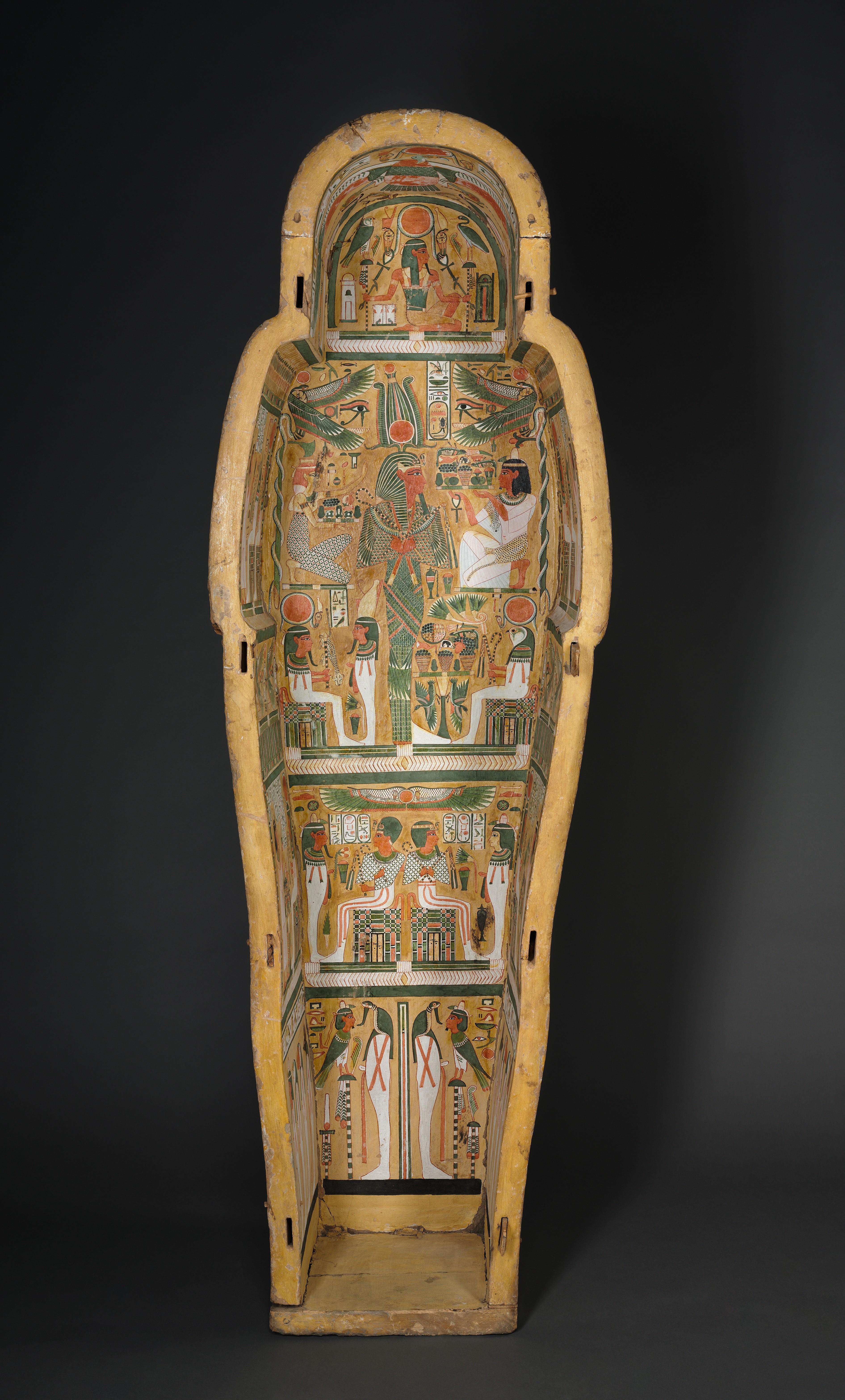
Coffin of Bakenmut, c. 1000–900 BCE. Egypt, Thebes, Third Intermediate (1069–715 BCE), Dynasties 21–22. Gessoed and painted sycamore fig ; overall: 68 cm (26 3/4 in.). The Cleveland Museum of Art, Gift of the John Huntington Art and Polytechnic Trust 1914.561.a
The coffin of Bakenmut is one of the finest examples of painted wooden coffins made for the priests of Amen and their families at Thebes during Dynasty 21 and early Dynasty 22. The pharaohs of this time were no longer buried in the Valley of the Kings, but instead built tombs in the Delta, far to the north, where they resided. Security was lax in the Theban necropolis. The coffins and funerary goods of the wealthy citizens of Thebes were placed in unmarked and undecorated family tombs cut into the cliffs on the west bank of the Nile. All the care and detail that in more prosperous times were devoted to the decoration of the tomb chapel were now lavished on the elaborately painted coffins. Every available surface is crowded with religious scenes, images of funerary gods and goddesses, protective spells, and magical symbols. The deceased appears mummiform. An elaborate floral collar entirely covers the upper body, exposing only the separately attached hands (now lost). A pair of red "mummy braces" are crossed over the chest, their point of intersection marked by a winged sun disk. The lower body is covered with tiny figures modeled in gesso against a yellow background, which gives the effect of gold inlaid with glass or semiprecious stone. The decoration on the interior features two deified dead kings of Dynasty 18. Although these rulers had lived centuries before, memory of their greatness was still very much alive. The main scene near the top depicts Tuthmosis III, the great military pharaoh, who lived 500 years before Bakenmut. Posed as a mummy, the ruler wears a brilliant feathered garment enfolding him with falcon’s wings. The scene below features back-to-back seated images of Amenhotep I, regarded as the patron of the Theban cemetery and worshiped as a local god there.
r/ancientegypt • u/Queasy_Present863 • 22h ago
Hello r/ancientegypt ! could someone explain to me how much we know about how Imhotep died, when he died and where he was buried? To my knowledge his mummy/tomb hasnt been found yet, so what do we know about where hes possibly buried, and do we know how and when he died?
r/ancientegypt • u/Queasy_Present863 • 1d ago
Hello r/ancientegypt , ive managed to find several sources that are full of Ancient Egyptian texts, however majority of them are religous texts that dont show much about the average egyptian, does anyone know any texts to look at that include the life of an average egyptian? such as diets, lists, general letters, things like that
thanks in advance !
r/ancientegypt • u/haberveriyo • 1d ago
r/ancientegypt • u/Yannie • 1d ago
r/ancientegypt • u/jpabloof • 1d ago
Enjoying the fireworks right in front of our hotel with the Giza Pyramids on Cairo, Egypt.
r/ancientegypt • u/Handicapped-007 • 1d ago
amulet
-664 / -332 (Early Middle Ages)
E 1734; N 4813; Clot bey C 21 V n°427
Department of Egyptian Antiquities
Inventory number Main number: E 1734
Another inventory number: N 4813
Previous coll. no.: Clot bey C 21 V no.427
Collection Department of Egyptian Antiquities
description
Object name/Title Designation: amulet
Description/FeaturesSelkis (scorpion with female head, right arm folded on chest, left arm folded on chest); with sling; missing sling
PHYSICAL CHARACTERISTICS
Dimensions Height: 3.1 cm; Width: 1.4 cm; Thickness: 0.8 cm
Materials and techniques Material: siliceous porcelain
Technique: round-back
Color: light brown-blue
PLACES AND DATES
Low Period Date (attribution based on style) (-664 - -332)
HISTORY
Collector / Previous owner / Commissioner / Archaeologist / DedicateeClot, Antoine Barthélémy, also called Clot Bey, Seller; Collector
Acquisition details purchase
Acquisition date date of arrival at the Museum: 1852
Owned by State
Held by the Louvre Museum, Department of Egyptian Antiquities
RENTAL OF OBJECT
Current location
Not exhibited
index
Mode of acquisition purchase
Name amulet
Silica-based materials
Round-body techniques
Description/Features folded right arm on chest - folded left arm on chest - scorpion with female head - Selkis - with belt - missing belt
Period Low Time
Last updated on 18.06.2025
The contents of this entry do not necessarily take account of the latest data.
Permalink: https://collections.louvre.fr/ark:/53355/cl010012524
JSON Record: https://collections.louvre.fr/ark:/53355/cl010012524.json
Title
Amulet -664 / -332 (Early Middle Ages) (attribution based on style), Findspot unknown Egypt, Siliceous porcelain, The Louvre Museum
https://collections.louvre.fr/en/ark:/53355/cl010012524
The Louvre Museum
.
r/ancientegypt • u/Handicapped-007 • 3d ago
Scarab: Scorpion Motifs
Date:
New Kingdom, Dynasties 18–19 (about 1550–1186 BCE)
Artist:
Egyptian
ABOUT THIS ARTWORK
Status
Currently Off View
Department
Arts of Africa
Artist
Ancient Egyptian
Title
Scarab: Scorpion MotifsPlace
Egypt (Object made in:)
Date
1550 BCE–1186 BCE
Medium
Steatite
Dimensions
0.6 × 1.6 × 1.1 cm (1/4 × 5/8 × 7/16 in.)
Credit Line
Gift of Charles L. Hutchinson
Reference Number
1894.1864
IIIF Manifest
https://api.artic.edu/api/v1/artworks/134469/manifest.json
PROVENANCE
Reverend Chauncey Murch (1859-1907), Luxor, Egypt; sold to the Art Institute of Chicago, 1894; price reimbursed by Henry H. Getty and Charles L. Hutchinson, 1894.
Title
Scarab: Scorpion Motifs, New Kingdom, Dynasties 18–19 (about 1550–1186 BCE), Findspot unknown Egypt, Steatite, The Art Institute of Chicago
https://www.artic.edu/artworks/134469/scarab-scorpion-motifs
The Art Institute of Chicago
r/ancientegypt • u/Handicapped-007 • 2d ago
Figure; Divine Sign
-664 / -332 (Early Middle Ages)
E 4586; 699
Department of Egyptian Antiquities
NumberMain number: E 4586
Presentation number: 699
Collection Department of Egyptian Antiquities
description
Object name/Title Designation: figurine; divine sign
Description/Feature scene of worship; man (kneeling, worshipping); Selkis (scorpion with woman's head, uraeus, disked horns)
PHYSICAL CHARACTERISTICS
Dimensions Height: 16.3 cm; Depth: 9 cm
Materials and techniques Material: copper alloy
Technique: round-back
PLACES AND DATES
Low Period Date (attribution based on style) (-664 - -332)
HISTORY
Collector / Previous owner / Commissioner / Archaeologist / DedicateeDelaporte, Pacific Henri, Seller; Collector
Acquisition details purchase
Acquisition date date of registration in the inventory: 11/21/1864
Owned by State
Held by the Louvre Museum, Department of Egyptian Antiquities
LOCATION OF OBJECT
Current location
Not exhibited
index
Mode of acquisition purchase
Name figurine - divine sign
Copper alloy materials
Round-body techniques
Description/Featuresadorant - man - worship scene - on knees - disked horns - scorpion with female head - Selkis - uraeus
Period Low Time
BIBLIOGRAPHY
Hornemann, Bodil, Types of Ancient Egyptian Statuary, 6, Copenhagen, Munksgaard, 1969, sheet 1539
Last updated on 02.07.2025
The contents of this entry do not necessarily take account of the latest data.
Permalink: https://collections.louvre.fr/ark:/53355/cl010006917
JSON Record: https://collections.louvre.fr/ark:/53355/cl010006917.json
Title
Figure; divine sign, Low Period Date (attribution based on style) (-664 - -332), Findspot unknown Egypt, Copper alloy, The Louvre Museum
https://collections.louvre.fr/en/ark:/53355/cl010006917
The Louvre Museum
r/ancientegypt • u/RyansKnowledgeRoom • 2d ago
Last week I posted a photo from meeting Professor Joann Fletcher at The Mummy screening at Smithills Hall in Bolton, and a few of you were interested, so I made a short video about the day.
It covers the drive up, the talk on the history of mummies, and meeting Joann. I’m on the Go Higher programme at the University of Liverpool, working towards studying Egyptology, so it was a special one for me. It also gets into how people in Europe used to eat mummies as medicine, and the 180,000 mummified cats sold in Liverpool in 1890.
Would love to hear what you think. Has anyone else been to one of her talks?
r/ancientegypt • u/WerSunu • 3d ago
Yesterday we had a lovely tour of this great museum of Ancient Egyptian culture, led by Dr Gobeil.
Some notes:
1)The fragmented linen is the first known example of painted, decorated fabric
2) A very early (Dyn 3?) statue of a woman
3) Coffin with palace facade decoration
4) a pleated tunic
5) a gallery full of ancient linen
6) models of workmen, left is cooking, right is kneading bread
7) a coffin with a calendar in the lid
9) an astronomer priest with stars replacing the leopard’s spots
10) types of ushabtis
11) rare husband and wife ushabtis
12) rare coffin model ushabti
13) some of the famed collection of ostraca art from Deir el Medina. Cedric was the director of the dig there
14) the actual Strike papyrus
15) gallery scene
16) detailed hieratic artwork in a book of the dead
17) Sekhmets from the Precinct of Mut, Luxor
19) Ramesses in center of triad with deities
20) Ramesses II
I tried to post the famous sarcastic/erotic papyrus, but Reddit censored it
r/ancientegypt • u/Handicapped-007 • 3d ago
Amulet of a Scorpion
Egyptian
New Kingdom
MEDIUM/TECHNIQUE
Faience
DIMENSIONS
Other: 2.8 cm (1 1/8 in.)
CREDIT LINE
Harvard University—Boston Museum of Fine Arts Expedition
ACCESSION NUMBER
27.879
NOT ON VIEW
COLLECTIONS
Jewelry, Africa and Oceania, Ancient Egypt, Nubia and the Near East
CLASSIFICATIONS
Jewelry / Adornment – Amulets
DESCRIPTION
Faience, blue glazed, brown bodied. Head end missing.
PROVENANCE
From Semna. S 523. March 2, 1924: Excavated by the Harvard University-Museum of Fine Arts Expedition; assigned to the MFA by the government of Sudan
Title
Amulet of a Scorpion, New Kingdom, Findspot Semna, Faience, The Museum of Fine Arts, Boston
The Museum of Fine Arts, Boston
r/ancientegypt • u/Handicapped-007 • 3d ago
Scarab Inscribed with a Hieroglyphic Motif
New Kingdom
ca. 1473–1458 BCE
On view at The Met Fifth Avenue in Gallery 116
Title: Scarab Inscribed with a Hieroglyphic Motif
Period: New Kingdom
Dynasty: Dynasty 18, early
Reign: Joint reign of Hatshepsut and Thutmose III
Date: ca. 1473–1458 BCE
Geography: From Egypt, Upper Egypt, Thebes, Deir el-Bahri, Temple of Hatshepsut, Foundation Deposit 9 (I), MMA excavations, 1926–27
Medium: Steatite (glazed)
Dimensions: L. 1.3 cm (1/2 in); w. 1 cm (3/8 in); h. 0.6 cm (3/8 in)
Credit Line: Rogers Fund, 1927
Object Number: 27.3.395
Curatorial Department: Egyptian Art
Provenance
Excavated by the Egyptian Expedition of the Metropolitan Museum of Art, 1926–1927. Acquired by the Museum in the division of finds, 1927.
References
Winlock, Herbert E. 1928. "The Egyptian Expedition 1925–1927: The Museum's Excavations at Thebes." In The Metropolitan Museum of Art Bulletin, vol. 23, no. 2, part 2 (February), p. 27, fig. 28.
Hayes, William C. 1959. Scepter of Egypt II: A Background for the Study of the Egyptian Antiquities in the Metropolitan Museum of Art: The Hyksos Period and the New Kingdom (1675-1080 B.C.). Cambridge, Mass.: Metropolitan Museum of Art, pp. 87–88, fig. 28.
Title
Scarab Inscribed with a Hieroglyphic Motif, New Kingdom ca. 1473–1458 BCE Early 18th Dynasty Joint reign of Hatshepsut and Thutmose III, Findspot Deir el-Bahri, Steatite, The Metropolitan Museum of Art
https://www.metmuseum.org/art/collection/search/549105
The Metropolitan Museum of Art