Hi everyone!
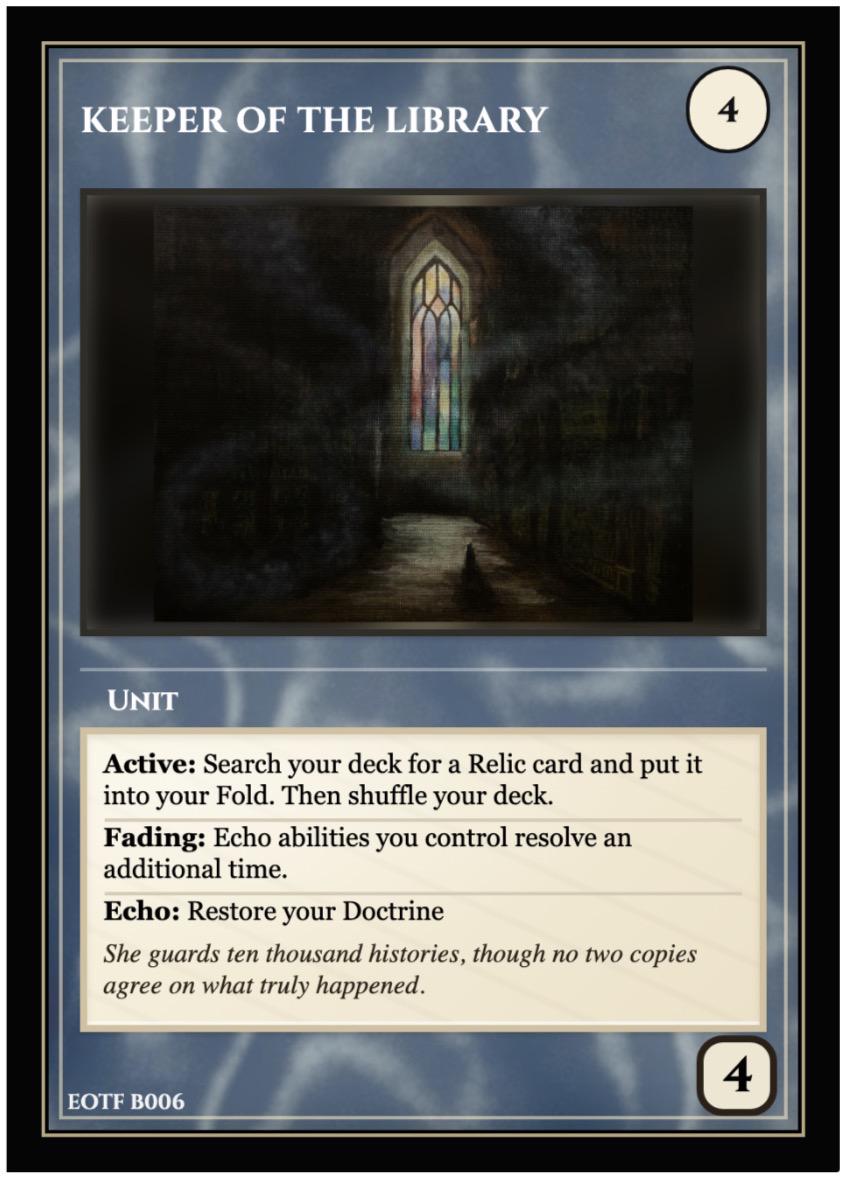
I'm working on an independent trading card game called Echoes of the Fold, and I've recently completed the first fully illustrated card.
I'd like to share a couple of design ideas I've been exploring and get some feedback from other designers.
The first is a unit lifecycle built around changing abilities.
Units progress through:
Active → Fading → Echo → Fold
Active and Fading are two different gameplay states, each with its own set of abilities.
When a unit transitions to Fading, it loses its Active text and starts using its Fading text. Echo is then a transient resolution state, where the unit performs its final ability before leaving for the Fold.
Units normally advance during the Fade Phase, but combat and certain effects can cause them to skip intermediate states.
The design goal is to make a unit's evolution part of the strategy, rather than treating its removal as a purely negative event.
The second idea is a resource system called Momentum.
Players gain Momentum through normal gameplay, but they're also allowed to spend more than they currently have, entering negative Momentum (Debt).
This creates an interesting tension between immediate tactical advantages and long-term resource management.
A player loses immediately upon reaching -7 Momentum, so taking on Debt is a meaningful risk.
There are also two other systems interacting with these mechanics:
- Three-lane combat, where players distribute units and compare total Power to determine damage and Collapse.
- Six Doctrines, where deck composition determines your Dominant Doctrine, its restrictions, and which additional abilities you can unlock through other Doctrine tags.
One challenge I'm particularly interested in is how these systems interact without overwhelming the player.
For example, the card I'm sharing, Keeper of the Library, has three different abilities corresponding to its Active, Fading, and Echo stages.
I'd love to get feedback on two questions:
- Does having different ability sets for Active and Fading units create interesting decisions, or would you expect it to increase cognitive load too much?
- How would you approach balancing a resource system where players can deliberately go into Debt?
I've also started a small Discord community where I'm discussing the rules, sharing new cards, and organising playtesting.
If anyone enjoys analysing game systems or testing early prototypes, I'd be happy to have you involved.
Discord: [https://discord.gg/5AbtwqTGB\]
Thanks for reading! I'm particularly interested in constructive criticism, so please don't hesitate to point out potential problems.