Infographic
I've been continuing my analysis of Michigan's offense under Jason Beck, looking for measurable patterns that might explain why we struggle so much to sustain momentum offensively.
One thing that's been frustrating to watch is how often Michigan makes a productive play, only for the offense to seemingly go nowhere immediately afterward.
So I wanted to see how Michigan compares to the rest of college football when it comes to stringing together substantial gains.
For this analysis, I looked specifically at conference games only for every team. That removes nonconference opponents from the comparison and gives us a more consistent look at how offenses perform against teams within their own conferences.
The question is simple:
When an offense gains 10 or more yards on a play, how often does its very next offensive play also gain at least 10 yards?
Here's what I found:
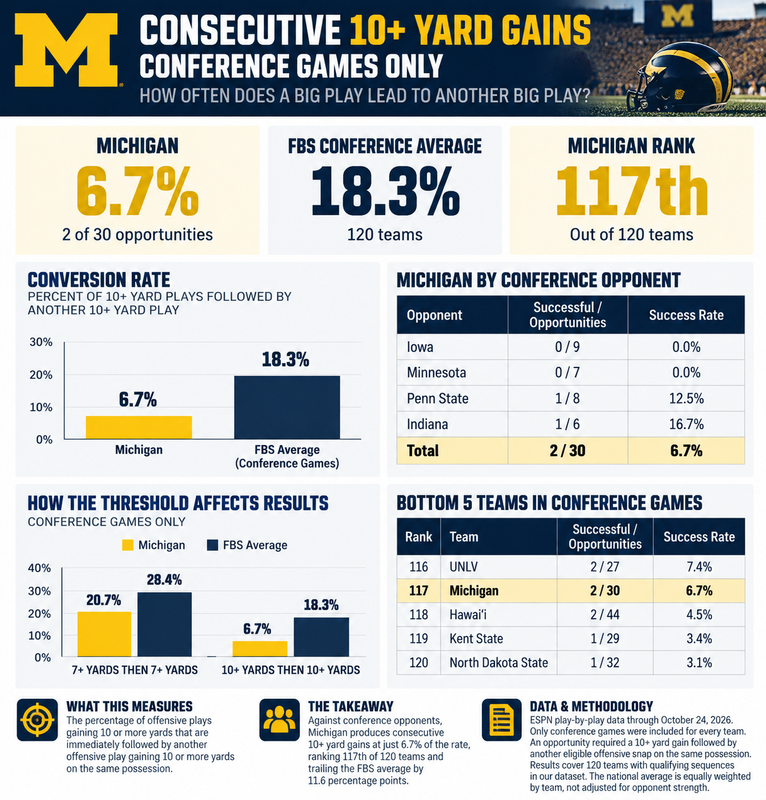
Michigan:
- 2 successful sequences in 30 opportunities
- 6.7% success rate
- 117th out of 120 FBS teams analyzed
FBS conference-game average:
- 18.3% success rate
Michigan is producing consecutive 10+ yard gains at roughly one-third the rate of the average FBS offense in our dataset.
Breaking it down by Michigan's Big Ten opponents:
- Iowa: 0 of 9 (0%)
- Minnesota: 0 of 7 (0%)
- Penn State: 1 of 8 (12.5%)
- Indiana: 1 of 6 (16.7%)
That's two successful sequences across four Big Ten games.
I also wanted to see whether this was simply a product of using a relatively demanding 10-yard threshold.
So I ran the same analysis using consecutive gains of 7 or more yards.
Michigan with a 7+ yard threshold:
- Michigan: 20.7%
- FBS average: 28.4%
- Michigan ranking: 105th out of 120
Even when we lower the threshold, Michigan remains near the bottom of the country.
Now, I want to make an important distinction here.
An offense doesn't need consecutive 10-yard plays to be successful. A 15-yard completion followed by a 5-yard run can be perfectly good offense. This isn't intended to measure overall offensive efficiency or first-down conversion rate.
What it does measure is how frequently an offense follows one substantial gain with another.
And Michigan has been particularly poor at doing that compared with other programs.
I've been critical of Beck's tendency to seemingly move away from what's working rather than building on successful plays. This statistic doesn't prove that's what's happening. There's a difference between a questionable play call and a good play that wasn't executed properly.
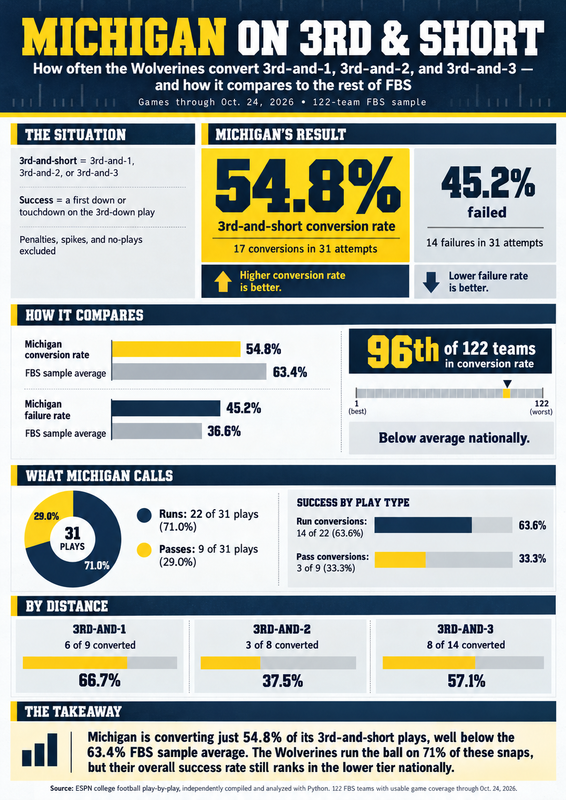
But when you combine this with some of the other numbers I've examined—Michigan's struggles with favorable second-down situations, third-and-short conversions, and sustaining successful passing plays—it starts to paint a concerning picture.
My biggest criticism isn't that Michigan never produces good offensive plays.
It's that Michigan seems incapable of consistently building on them.
At what point do we start questioning whether the offensive philosophy itself is contributing to that?
Data Source & Methodology
All statistics were calculated using ESPN college football game-level play-by-play data from the 2026 season through October 24.
I downloaded the game records and used Python to analyze consecutive offensive plays across the FBS programs represented in the dataset.
For this specific analysis:
- Only games officially identified as conference matchups were included.
- The first offensive play had to gain at least 10 yards.
- The immediately following eligible offensive play had to gain at least 10 yards to count as a success.
- Both plays had to occur during the same offensive possession.
- Runs and passes were included.
- Special teams plays, timeouts, and administrative events were excluded.
- Each team's success percentage was calculated independently.
- The FBS average represents the equally weighted average of the teams in the comparison.
Limitations: The analysis includes 120 teams with qualifying conference-game sequences, not every FBS program. Teams have played different numbers of conference games, and the results aren't adjusted for opponent strength or game situation. Michigan also has only 30 qualifying opportunities, so individual plays can significantly affect its percentage and ranking.
This measures consecutive substantial gains, not overall offensive efficiency, and shouldn't be interpreted as direct proof of poor play-calling.
Source: ESPN College Football play-by-play data, independently compiled and analyzed using Python.