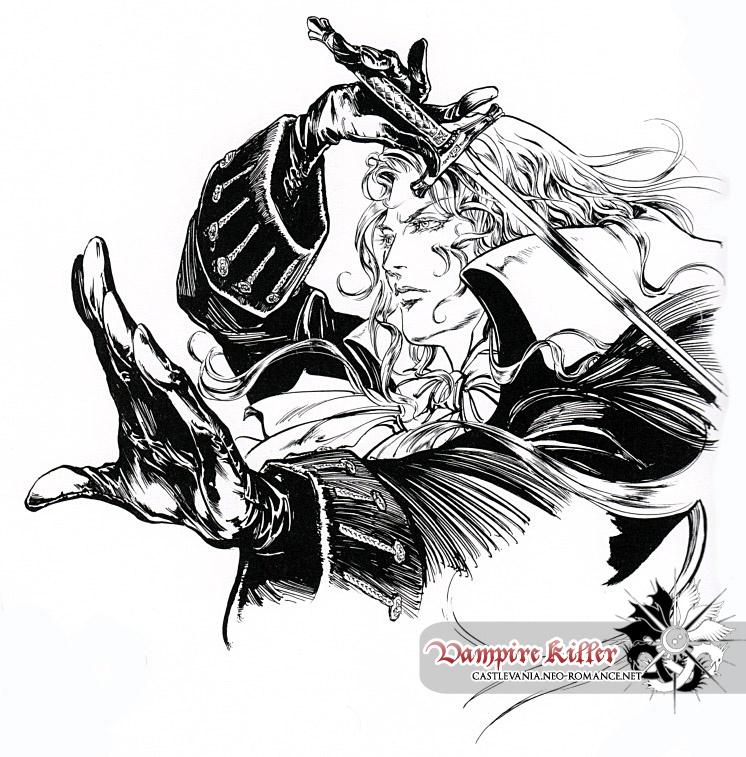
An eight pages long manga included in the Japanese artbook, it acts as a prologue for the main story and features Alucard suddenly awakening from his 300 years long slumber.
A radio drama (this time you have to listen to it!) originally featured on the Akumajō Dracula: Radio Chronicle program that was broadcast on Konami Station internet radio, it was later released on CD in 2010. It's a story set one year after the events of the game, you will learn more about Alucard's relationship with Maria, his past and other characters (Richter is also part of the cast).
A prequel manga written and illustrated by Kojima, it was featured as a pre-order bonus for the Japanese release of the game. It mainly focuses on Hector and Isaac prior to the events of the game, it also expands on their relationships.
Available on: Vampire Killer (an archive of scans and translations)
Published in two volumes by Media Factory from 2005 to 2006 and translated to English by Tokyopop in 2008. It's the same premise but it's longer, more expansive and this time the illustrator is Kō Sasakura, not Ayami Kojima. The series was eventually canceled but the manga stops directly where the game begins.
A light novel written by Ryōgo Narita in 2008 and set one year after Dawn of Sorrow. It's a really interesting read, the story focuses on Julius' pupil and the descendant of Grant Danasty while the villain is a character you will surely remember... There's also the return of familiar faces, one in particular.
It's a 2005 IDW comic book series loosely based on the story of the first Game Boy game. It's not canon by any means but it follows Christopher Belmont in a more traditional vampire story, sadly many of the iconic Castlevania elements are missing but it's still worth a read since here a certain family is responsible for Dracula's resurrection.
A web manga that was available on cellphones via a monthly subscription, published from 2007 to 2008 only in Japan until the service ended in 2012. It was a 43 issues long series that adapted the story of Leon Belmont and greatly expanded the plot, what remains now is only a Japanese review blog. If you want to know more about it you can visit the Castl)evania Wiki page).
Available on: Internet Archive's Wayback Machine (review blog)
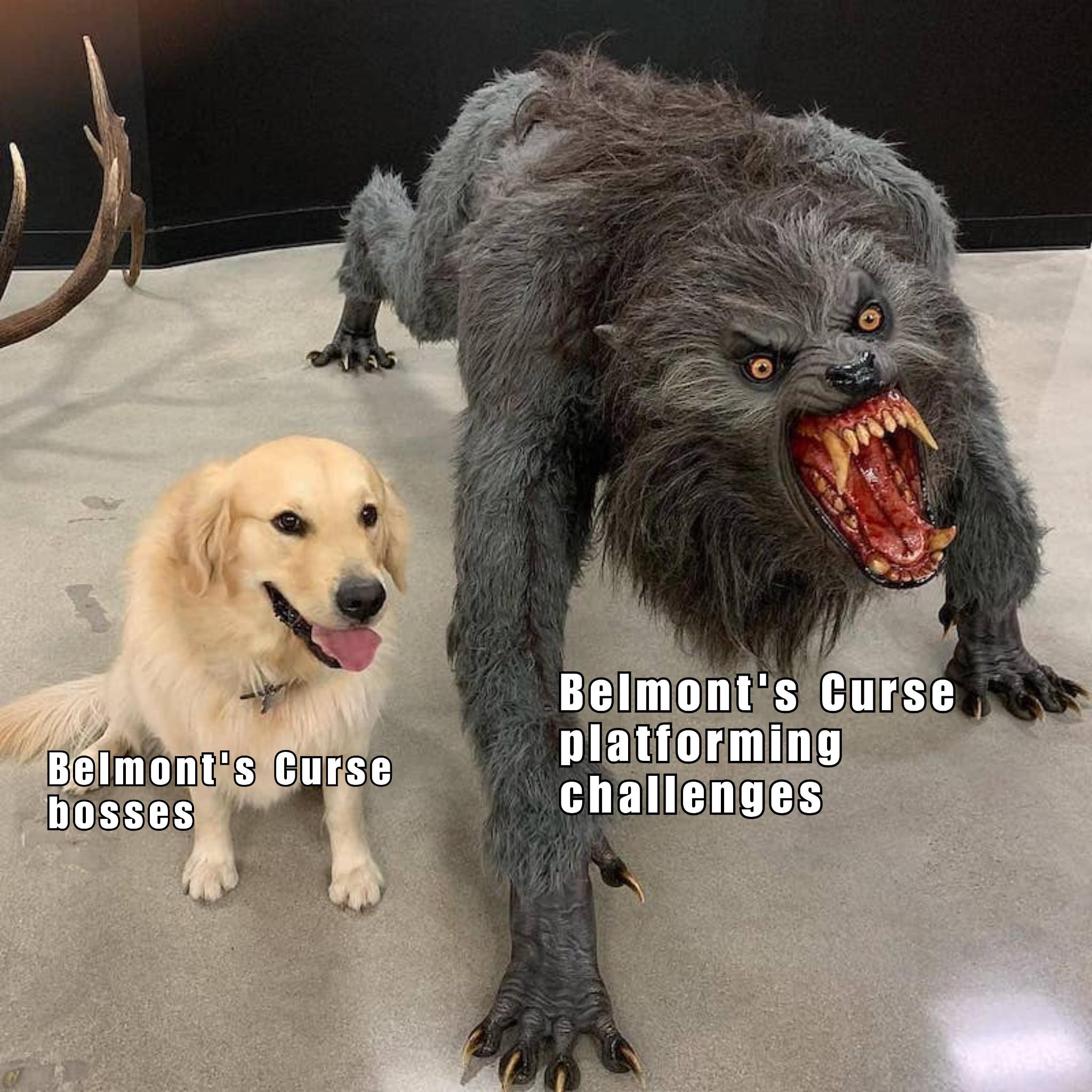
Don't get me wrong, I still love it. It's some of the best platforming in a Metroidvania that I've ever played alongside The Lost Crown and Ori, but it's definitely a step up in challenge compared to other Castlevanias.
It's not my first metroidvania, but it is finally the first Castlevania game that I've ever played, I really don't know why it was so criticized on social media when it's one of the best metroidvanias in the last 10 years imo. I think I'm going to start playing other games from the franchise like Order of Ecclesia or SoTN. I've watched all of the Netflix animated show seasons and ever since I felt the need to try these games. I hope Sotn gets release on steam someday... but if that's not the case emulation will be.
P.D. no god mode for the speedrun achievement (I like to suffer)
Amidst all the heated discourse about whether Belmont's Curse is a "real Castlevania game" (whatever your definition of that might be) I feel like... almost no one actually brings up examples of the games in question to illustrate their points? So that's what I'll do here.
A large part of this debate can be quelled by explaining that Castlevania does not play like most modern Metroidvanias. Despite the name, the genre is rarely influenced by Castlevania itself. But what exactly is the-vaniapart in the formula, then?
Well, we should clarify something first. "Metroidvania" was never meant to describe the genre originally. In ye olde days, players coined the term specifically referring to Castlevania games which played similar to Metroid (those being Symphony of the Night, Circle of the Moon, Aria of Sorrow, as opposed to level-based platformers like Rondo of Blood or Castlevania 3). It was NOT supposed to refer to a supposed genre that fused elements of Metroid and Castlevania. Obviously we use the term differently now.
But that begs the question...
What did Castlevania: Symphony of the Night add to the genre that wasn't already in Metroid?
RPG elements! 100%, I believe this is the core that everyone glosses over. SOTN is essentially a light action RPG with Metroid style map design. These form the backbone of its gameplay:
Leveling through an EXP system
Staple character stats like HP, MP, strength, intelligence, defense, and luck
Equipment slots for weapons, armor, and accessories
Consumable items to heal, cure status effects, raise stats, or deal damage
Enemy loot tables and item farming (so much farming)
Is this a Final Fantasy menu or what?
These features might not be as robust as a traditional RPG, but this was the foundation that Castlevania followed from here on. Later installments would add quests, ability slots, more elemental focus, and crafting. This is why we have the Classicvania and Igavania distinction. To drive home my point, let me describe an experience that would sound insane to most Metroidvania fans (but familiar to retro RPG fans):
To get the most powerful weapon in the game (Crissaegrim), you must farm one specific enemy near the endgame for its rare drop. Nothing in the game tells you this, so you find this out through GameFaqs, a guidebook, or sheer curiosity. You kill the enemy in one hit, so you backdash out of the room and return to respawn it. One cycle takes less than 3 seconds. You equip luck-increasing gear and optimize your movement. After anywhere between 20 minutes to 2 hours, you finally obtain the sword... then you do it again so you can dual wield it.
Not through a particularly hard boss or platforming challenge. Not even through a questline, hidden area, or equipment upgrade. Just a random ass enemy with a 0.17% chance drop for the best weapon in the game. And you don't even need it, because the game is already easy! Even without trying, there's a dozen ways to break the game!
This is just one of the quirks that sets Castlevania apart from other games. Most casual playthroughs didn't do this, obviously, but a defining characteristic of these games is working your way towards being ridiculously OP by the end. It's a power fantasy that has you constantly hunting stronger things to give dopamine. That's downright antithetical to other games which try to maintain a semblance of balance, opting to emphasize player skill over equipment strength. I'm not saying Igavanias were perfect for doing this, it's just the consequence of having more of an RPG influence.
Alright, what are games that DO play like Castlevania/Igavania then?
Besides the RPG elements, I'd also say these games are notoriously light on actual platforming. Gamers look at you like a crazy person if you say, "I prefer less platforming when I play Metroidvanias". It's like you just told them you enjoy eggless omelets. Yet that's the weird truth. These games tend to lean towards pure combat—some tricky jumps here and there, but levels are largely defined by enemy placement and their behaviors. There's plenty of plain hallways filled with enemies. And there's virtually no airdashing or wall jumping around sawblade mazes a la Super Meat Boy. That style of platforming wasn't Castlevania's shtick even before SOTN, and I think it's disingenuous to imply the games were like that historically.
There's also something about the movement and attacking in these games that feels distinct. Some people think it's sluggish and limited, other people think it's buttery smooth and responsive. Weird how subjective taste works. Still, you can usually clock these games just by watching the character run around. Here's two games which (lovingly) copy the style.
Record of Lodoss War: Deedlit in Wonder Labyrinth is a brief-but-insanely-stylish take on the SOTN framework. It's not a perfect game, but it's proof that you can absolutely do more within this formula without needing to change the fundamental mechanics or game feel. Check out the dev's other games too, like Touhou Luna Nights or Blade Chimera.
And of course, Bloodstained: Ritual of the Night is legally distinct Castlevania in every way possible. Directed by Igarashi himself, it's basically the kitchen sink of all of his previous games. It's janky, needs polish, and kind-of ugly honestly... but my god, it's charming in how blatant it is. If you unironically love grinding and making builds, this one's for you. The sequel looks like an improvement on all fronts, but only time will tell.
I just wish the quests were better.
Look at either of these games and pull up other Metroidvanias to compare. Hollow Knight, Super Metroid, Blasphemous, Guacamelee, Momodora: Reverie Under the Moonlight, Ender Lilies, Prince of Persia: The Lost Crown, La-Mulana, etc. etc. and you'll notice that games which do specifically what Castlevania did are honestly rare.
Okay, how does this relate to Belmont's Curse?
I actually can't say much here because I only played the demo teehee :D
But now you know why there's different crowds of fans who have completely different ideas of what Castlevania should be—people came into the series at different points and fell in love with different parts of it. People only getting into it nowadays might have a background in Hollow Knight or other modern titles, with no attachment to the previous stuff. Maybe there's weirdos who enjoy everything, I dunno. Whether or not you think it's a good thing that Belmont's Curse grafts DNA from newer games is up to you.
And if you're someone like me who shamelessly prefers the -vania part of Metroidvanias, please share the latest Bloodstained: The Scarlet Engagement trailer to people. It's stupid anime JRPG bullshit and I adore it
The only achievement left is bearing the game in under what 3 or 4 hours? Not sure if I'll embark on that.
Overall this was a great game with only a few bugs I ran into(had the game glitch out after beating someone who uses all my moves. Just started shaking and crashed.
The controls were almost perfect but I had issues with the whip direction. Especially on some particularly annoying platforming sections. Lounge I want to use it in one direction but it ignores my input.
A very minor annoyance so I guess this is really a 10/10.
I'm not sure if anyone has brought this up yet but make sure to visit Trevor in Notre Dame after you get the final Arcana for some extra dialogue.
Also, if you talk to Trevor a few more times, he'll have something to say about every other Arcana. A lot of them try to respond, but only Rose can hear them.
Estou jogando Super Castlevania IV novamente e, como me lembrava, a curva de dificuldade do jogo aumenta significativamente depois de entrar no Castelo, tanto em termos de desafios de plataforma quanto na quantidade de inimigos, você também compartilha dessa opinião, ou é apenas falta de habilidade da minha parte?
AWESOME! : D I will finally be able to play Symphony of the Night without having to worry about missing Stuff from any Versions now... ^_^ :3
This is arguably even better than an Official PC Port to Steam or something since I doubt Konami would include all the Content from ALL Previous Versions of the Game into one Game like this... ^_^
There are so many people complaining about the platforming when it literally isn't that bad. Like it is way easier than any of the platforming in the classicvanias, play castlevania on the NES or play Rondo of Blood and then get back to me, this complaint is so tired.
Some of you have never played a game that had actually difficult platforming and it really shows.
finished BC recently and one thing ive been wondering is why brauner isnt olrox instead
my memory could be failing me but didnt brauner get turned into a vampire just shortly before the events of PoR? and since thats so much further in the future, is the brauner family just historically affiliated with dracula? or is it like the same guy reincarnated??? it just seems so strange to me
when i saw him in promo before the game released i was sure it was like nosferatu or maybe olrox returning, esp its earlier in the timeline and brings back some old school drac minions like carmilla and medusa and isaac (timeline wise)
anyone else have any thoughts on this? brauners card was also one of the few i didnt do all the works of mercy on so maybe i just missed out on some juicy lore lol
Sylpha Belnades... Maria Renard... Sonia Belmont... Yoko Belnades... Charlotte Aulin... Shanoa... And now Rose Belmont...
Not counting of course Characters like Carmilla who were only Playable in that Fighting Game Castlevania Judgement since that barely counts lol... XD
Did I miss anyone? :)
Who do you think is the most Popular Gal among the Playable Characters? :)
I personally think it is Maria Renard due to her appearing the most in several Entries and at different Ages too ( Kid and Young Adult ) and being the closest thing to Alucard having a Canonical Love Interest since Sonia Belmont was removed from the Main Canon...
Shanoa seems to have a fair amount of Fans too...
Sylpha became more Popular after the Animation I suppose but before that didn't feel like it much going only by the Games but she was technically the First Playable Female Character in Castlevania...