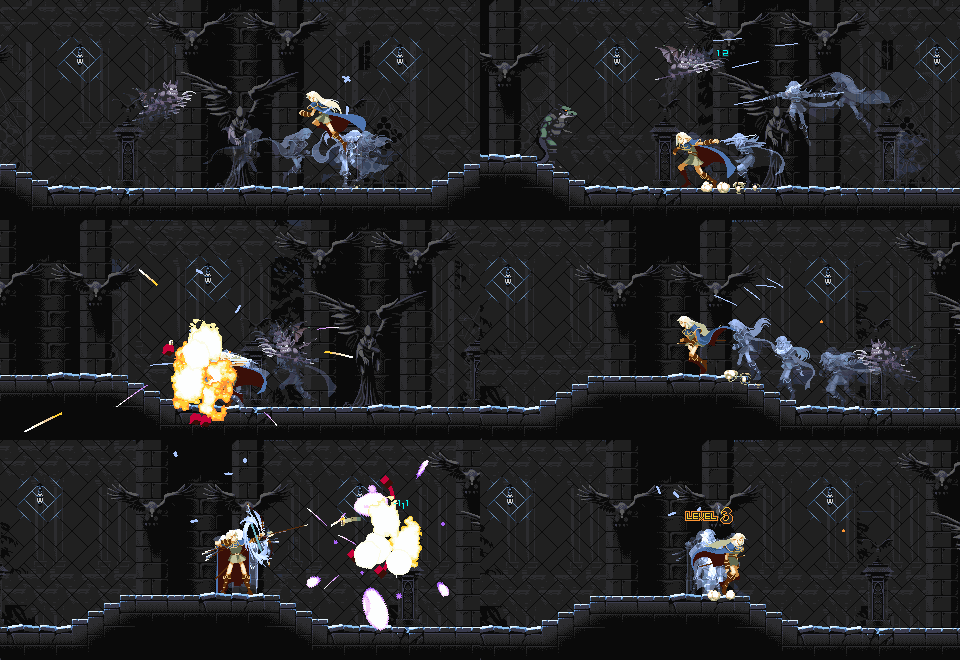
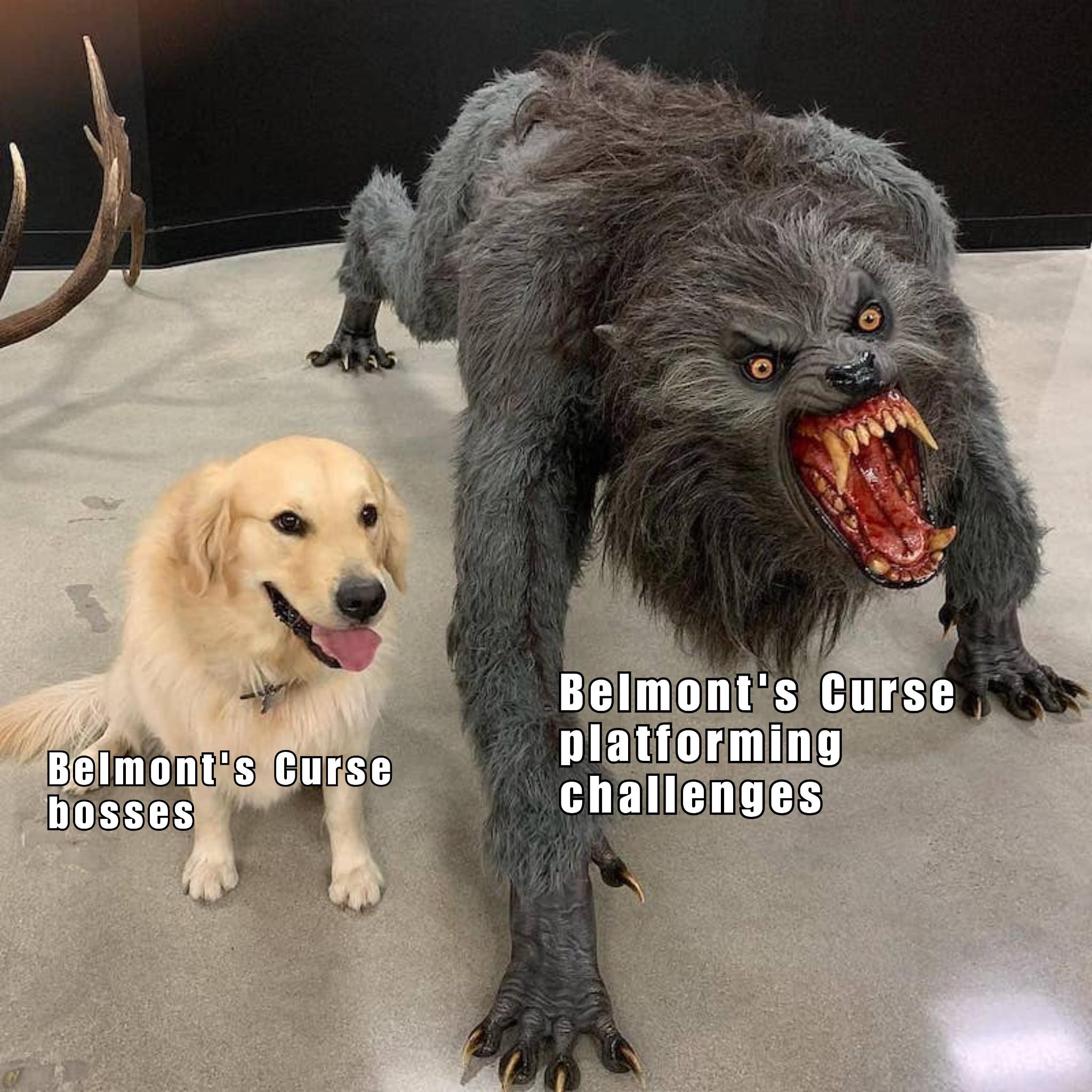
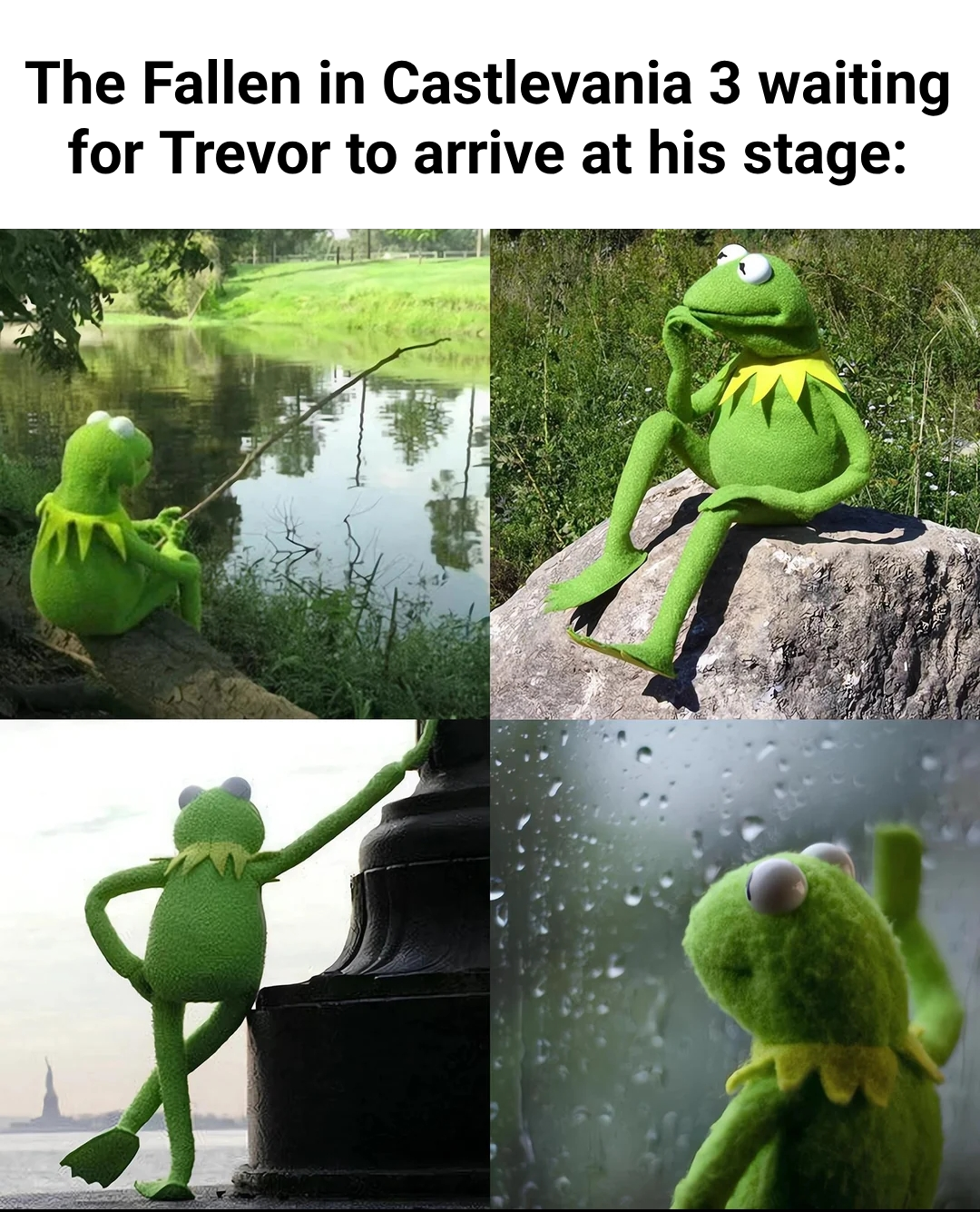
Don't get me wrong, I still love it. It's some of the best platforming in a Metroidvania that I've ever played alongside The Lost Crown and Ori, but it's definitely a step up in challenge compared to other Castlevanias.
It's not my first metroidvania, but it is finally the first Castlevania game that I've ever played, I really don't know why it was so criticized on social media when it's one of the best metroidvanias in the last 10 years imo. I think I'm going to start playing other games from the franchise like Order of Ecclesia or SoTN. I've watched all of the Netflix animated show seasons and ever since I felt the need to try these games. I hope Sotn gets release on steam someday... but if that's not the case emulation will be.
P.D. no god mode for the speedrun achievement (I like to suffer)
Trevor: Ok, I managed to get directions to the bishops house, let's see if he can explain about the inconsistencies in his letter annnnnnnnnnnndddddddd that's a dead body.
Now, investigative work. Did someone kill the Bishop? No, no, clothes are too simple, the guy in the letter clearly liked wealth, he'd dress for success for sure. So someone killed a second clergy member. Let's look around to see why.
...Ok, found the letters, he clearly was given a cursed artifact. Probably warped his mind, went insane, killed a former ally to cover his skin. Probably got asked to send the letter too. Question is, again, by whom? What master did he serve? Let's cross reference the letter, see if we can find anything new.
Hrrrrrm... the letter mentions tithes, but that's not exactly new information.... "A darkness greater then any pestilence or war..." What's worse then... OH. OH FUCK. OH FUCK IT'S DEATH. IT'S FUCKING DEATH.
...Right shit, don't panic just yet. You've beaten Death before. Now, where would he hide? Catacombs, obviously. Rose will probably meet me here soon. Leave a note saying don't go into the Catacombs no matter what, then head there.
...The door to the catacombs is open. THE DOOR TO THE CATACOMBS IS RIGHT FUCKING OPEN THAT MEANS ROSE IS DOWN THERE WITH DEATH OH SHIT OH FUCK OH SHIT OH FUCK DOUBLE TIME RIGHT THE FUCK NOW
Amidst all the heated discourse about whether Belmont's Curse is a "real Castlevania game" (whatever your definition of that might be) I feel like... almost no one actually brings up examples of the games in question to illustrate their points? So that's what I'll do here.
A large part of this debate can be quelled by explaining that Castlevania does not play like most modern Metroidvanias. Despite the name, the genre is rarely influenced by Castlevania itself. But what exactly is the-vaniapart in the formula, then?
Well, we should clarify something first. "Metroidvania" was never meant to describe the genre originally. In ye olde days, players coined the term specifically referring to Castlevania games which played similar to Metroid (those being Symphony of the Night, Circle of the Moon, Aria of Sorrow, as opposed to level-based platformers like Rondo of Blood or Castlevania 3). It was NOT supposed to refer to a supposed genre that fused elements of Metroid and Castlevania. Obviously we use the term differently now.
But that begs the question...
What did Castlevania: Symphony of the Night add to the genre that wasn't already in Metroid?
RPG elements! 100%, I believe this is the core that everyone glosses over. SOTN is essentially a light action RPG with Metroid style map design. These form the backbone of its gameplay:
Leveling through an EXP system
Staple character stats like HP, MP, strength, intelligence, defense, and luck
Equipment slots for weapons, armor, and accessories
Consumable items to heal, cure status effects, raise stats, or deal damage
Enemy loot tables and item farming (so much farming)
Is this a Final Fantasy menu or what?
These features might not be as robust as a traditional RPG, but this was the foundation that Castlevania followed from here on. Later installments would add quests, ability slots, more elemental focus, and crafting. This is why we have the Classicvania and Igavania distinction. To drive home my point, let me describe an experience that would sound insane to most Metroidvania fans (but familiar to retro RPG fans):
To get the most powerful weapon in the game (Crissaegrim), you must farm one specific enemy near the endgame for its rare drop. Nothing in the game tells you this, so you find this out through GameFaqs, a guidebook, or sheer curiosity. You kill the enemy in one hit, so you backdash out of the room and return to respawn it. One cycle takes less than 3 seconds. You equip luck-increasing gear and optimize your movement. After anywhere between 20 minutes to 2 hours, you finally obtain the sword... then you do it again so you can dual wield it.
Not through a particularly hard boss or platforming challenge. Not even through a questline, hidden area, or equipment upgrade. Just a random ass enemy with a 0.17% chance drop for the best weapon in the game. And you don't even need it, because the game is already easy! Even without trying, there's a dozen ways to break the game!
This is just one of the quirks that sets Castlevania apart from other games. Most casual playthroughs didn't do this, obviously, but a defining characteristic of these games is working your way towards being ridiculously OP by the end. It's a power fantasy that has you constantly hunting stronger things to give dopamine. That's downright antithetical to other games which try to maintain a semblance of balance, opting to emphasize player skill over equipment strength. I'm not saying Igavanias were perfect for doing this, it's just the consequence of having more of an RPG influence.
Alright, what are games that DO play like Castlevania/Igavania then?
Besides the RPG elements, I'd also say these games are notoriously light on actual platforming. Gamers look at you like a crazy person if you say, "I prefer less platforming when I play Metroidvanias". It's like you just told them you enjoy eggless omelets. Yet that's the weird truth. These games tend to lean towards pure combat—some tricky jumps here and there, but levels are largely defined by enemy placement and their behaviors. There's plenty of plain hallways filled with enemies. And there's virtually no airdashing or wall jumping around sawblade mazes a la Super Meat Boy. That style of platforming wasn't Castlevania's shtick even before SOTN, and I think it's disingenuous to imply the games were like that historically.
There's also something about the movement and attacking in these games that feels distinct. Some people think it's sluggish and limited, other people think it's buttery smooth and responsive. Weird how subjective taste works. Still, you can usually clock these games just by watching the character run around. Here's two games which (lovingly) copy the style.
Record of Lodoss War: Deedlit in Wonder Labyrinth is a brief-but-insanely-stylish take on the SOTN framework. It's not a perfect game, but it's proof that you can absolutely do more within this formula without needing to change the fundamental mechanics or game feel. Check out the dev's other games too, like Touhou Luna Nights or Blade Chimera.
And of course, Bloodstained: Ritual of the Night is legally distinct Castlevania in every way possible. Directed by Igarashi himself, it's basically the kitchen sink of all of his previous games. It's janky, needs polish, and kind-of ugly honestly... but my god, it's charming in how blatant it is. If you unironically love grinding and making builds, this one's for you. The sequel looks like an improvement on all fronts, but only time will tell.
I just wish the quests were better.
Look at either of these games and pull up other Metroidvanias to compare. Hollow Knight, Super Metroid, Blasphemous, Guacamelee, Momodora: Reverie Under the Moonlight, Ender Lilies, Prince of Persia: The Lost Crown, La-Mulana, etc. etc. and you'll notice that games which do specifically what Castlevania did are honestly rare.
Okay, how does this relate to Belmont's Curse?
I actually can't say much here because I only played the demo teehee :D
But now you know why there's different crowds of fans who have completely different ideas of what Castlevania should be—people came into the series at different points and fell in love with different parts of it. People only getting into it nowadays might have a background in Hollow Knight or other modern titles, with no attachment to the previous stuff. Maybe there's weirdos who enjoy everything, I dunno. Whether or not you think it's a good thing that Belmont's Curse grafts DNA from newer games is up to you.
And if you're someone like me who shamelessly prefers the -vania part of Metroidvanias, please share the latest Bloodstained: The Scarlet Engagement trailer to people. It's stupid anime JRPG bullshit and I adore it
Been playing Belmont's Curse and got the urge to make some Magic the Gathering cards from Castlevania. These are the first batch. Wanted to see what Castlevania fans think of these.
The only achievement left is bearing the game in under what 3 or 4 hours? Not sure if I'll embark on that.
Overall this was a great game with only a few bugs I ran into(had the game glitch out after beating someone who uses all my moves. Just started shaking and crashed.
The controls were almost perfect but I had issues with the whip direction. Especially on some particularly annoying platforming sections. Lounge I want to use it in one direction but it ignores my input.
A very minor annoyance so I guess this is really a 10/10.
Well, to be fair, I felt like this is a fitting title to help boost some views and catch a few eyes
But mainly, it's because I want to talk about one of my favorite belmomts, and how Belmont's curse adds on top of his already tragic story and fate
Leon is by far, I think, one of the most important figures in castlevania history
Whether you played LoI, or seen his portrait in the Netflix show, it is no secret Leon is important for starting the Belmont name
But his life is a tragic one
I have heard people say this revelation made Leon from a iconic and powerful Belmont into a "Bish" to some people's eyes
I however, think this adds on his tragic past
Leon lost everything, abandoned his company, lost the friend he cared who would become Dracula, and even his lover, who willing let her be sacrificed into Leon's whip to make the vampire killer
Belmont's curse has effectively add more, as Leon, while he didn't fully confront and face off against Mathias, he did meet him again, however, people miss understood this, but let me explain and help picture this in your heads
Leon has been spending his days trying to hunt down Mathias, even if he was able to continue the bloodline, he was hell bent on hunting his old friend down and killing him, except, he couldn't find him
Years goes by, weeks turn into days, Leon essentially got old, and was slowly dying, likely worried about humanity's safety and the promise to Sara, he was going to die, until Mathias shows up, obviously, it is a trap, but to Leon, he hope that his old friend was still there as they talked
However, Mathias was exploiting that weakness in Leon, afterwards, Leon would show up in Paris, although he doesn't remember making his way, he would be a monster, backstab by his friend and turn into a monster he sworn to kill, just as he was about to die in his deathbed
If there is anything to take from this, Mathias abuse his friendship with Leon, turn it into a weapon against him, and by the time he notice the spell, it was too late
Mathias caught him at his weakest and toke the opportunity
It also really tell you how much Dracula himself can be manipulative, and it is haunting, to say the least
I don't like Metroidvania, but Hollow Knight and Belmont's Curse are my favorites.
I didn't watch anything before the game dropped and when I saw Joan of Arc, I loved the historical fact about her in real life and I loved how they put it in the game.