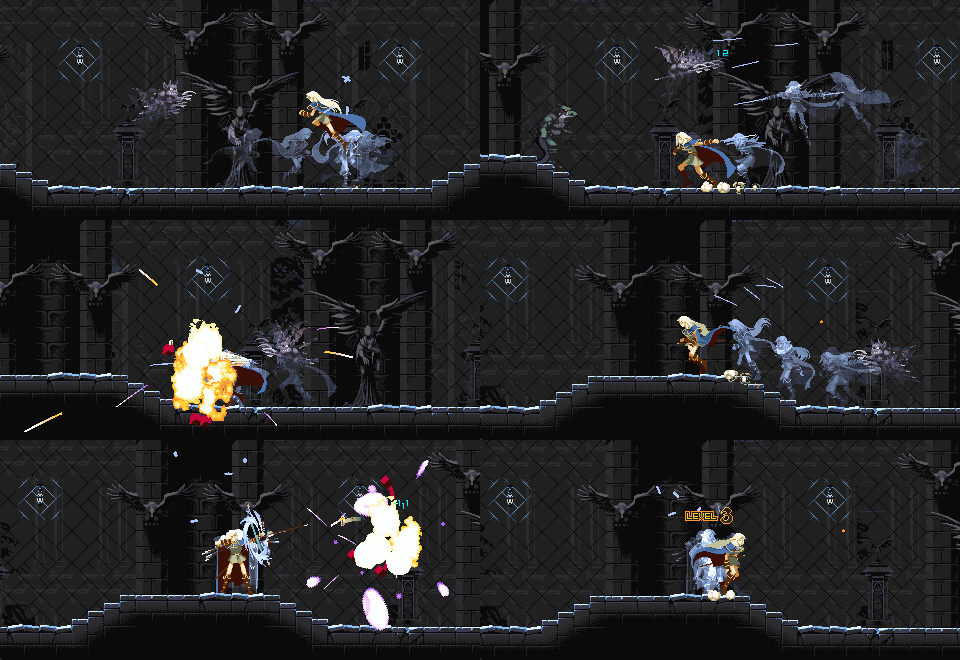
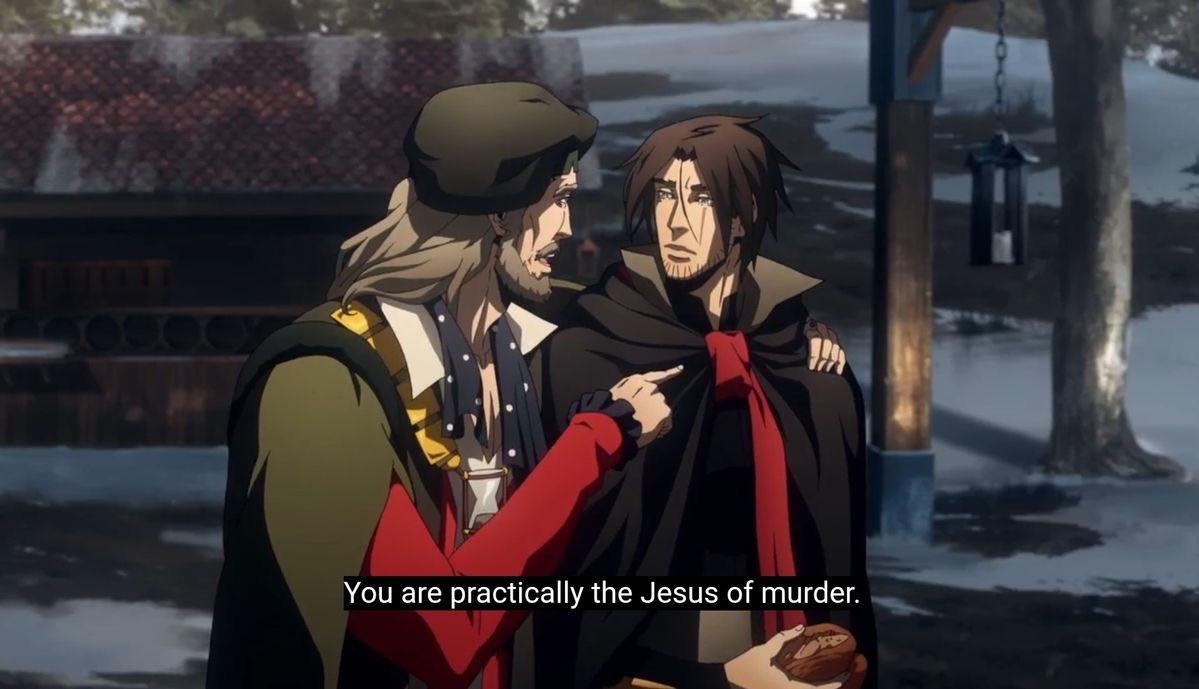
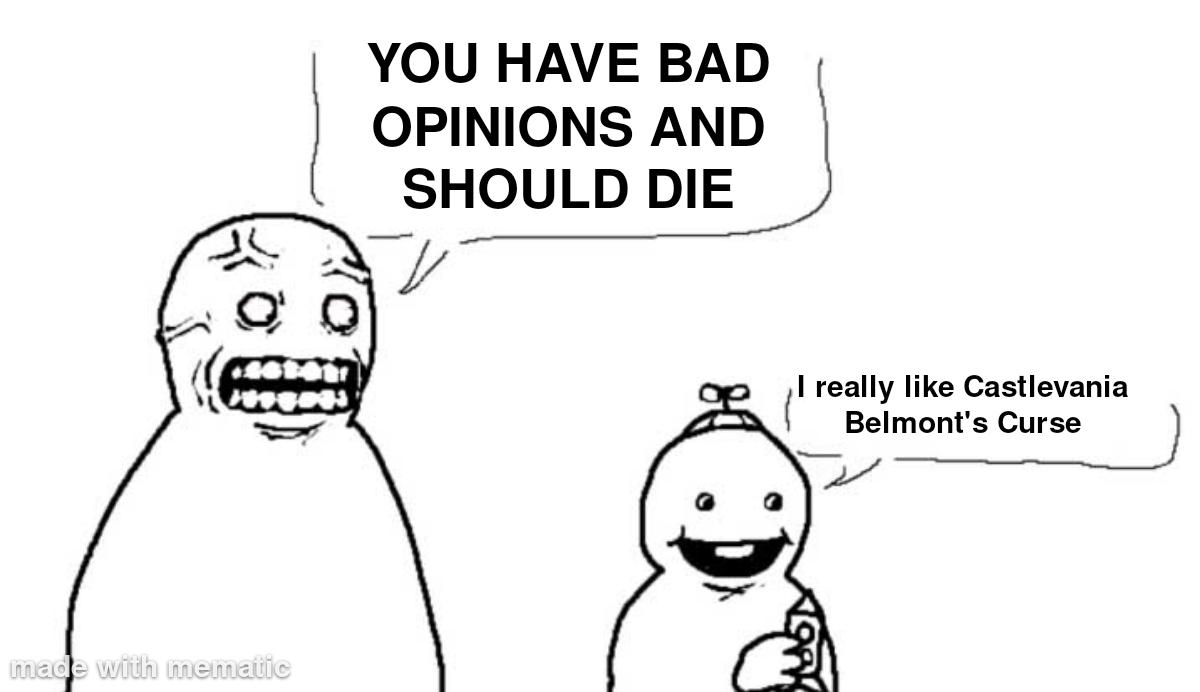
There are so many people complaining about the platforming when it literally isn't that bad. Like it is way easier than any of the platforming in the classicvanias, play castlevania on the NES or play Rondo of Blood and then get back to me, this complaint is so tired.
Some of you have never played a game that had actually difficult platforming and it really shows.
Not trying to be another ranter trying to poke holes in the game. I am enjoying this thing way too much and it's been a beautiful experience playing it.
I'm currently in Master's Quarters, and I was expecting a wild ride. I've only played the GBA/DS games and I have loved every pre-Dracula final area. If we just look at Aria of Sorrow, the Top Floor was just great. It had rare enemies (Stolas, Basilisks), Succubi that pretended to be Mina, the Iron Golem (an enemy with a unique gimmick and only available on the Top Floor), and a great selection of visuals - fiery halls, an open exterior section, a haunting ascent.
Compare Belmont's Curse. It's three straightforward rooms. They crammed some tough enemies into it, but by endgame, you are likely 3-4 shotting them and an the same enemies you've been seeing throughout the game. Idk about you but in the other games, I usually feel intimidated by the enemies in the final areas. Think of the Double Hammers from Order of Ecclesia, they gave me trouble well into the postgame. Here, all the enemies are pushovers by the time you are ready for the final boss.
I have tried to fight him again and again and each time he shreds through me like I'm made of butter. I've never been able to take off more than a quarter of his health. This is the first boss??? I asked people and they said that I'm supposed to slide through him to dodge his claw attack, but every time I try he turns around and shreds me on the third slash. Is there a health upgrade I'm missing or something? I know you're supposed to break his cross that he throws at you but it seems I'm just not fast enough to parry his attacks.
I have had lament of innocence and curse of darkness on my shelf for over 15+ years and I never played them. I popped lament in once but it didn't pull me in.
Today out of curiosity I popped the disc in my old ps2 and man smear graphics aside (although the transition effects are nice) the game plays way more what I would expect a 3d castlevania to play like.
I own lords of shadow and hated it. It was all cinematic set peice qte, god of war but not and 20x worse. The story was lame the chunky gears of war sized characters, lame. The weapons and atmosphere was not castlevania. Why do people like that mess?
I am actually digging lament, and I dig the music, the Gothic style is intact. That enemies and power ups all here. My only complaints so far is the whip jump grapple is a pain in the ass. Also why no leveling? This could of been sotn in 3d. Which honestly is what I have always wanted, but an actual metroidvania 3d rpg not a our action game like Los. Think dark souls level layouts but faster movement and more platforming. Gothic themed and not as hard bosses. I could see it being done.
How does everyone like the ps2 cv games? Any news on a collection? These are the only mainline games I haven't really played (and los2 which why would I bother if I hated the first).
A game along the lines of Super Castlevania 4 or Rondo of Blood would be very welcome. 8-directional whipping is a must (so unfortunate that SC4 is the ONLY game with this mechanic). I would like a short, 3-4 hr game where every stage is balls to the wall hard. You must learn the level inside out, where each item is, where the enemies are, figure out the platforming and plan a route - only then can you progress through the level and finish it. I want no backtracking, no side paths, no RPG mechanics - just an exquisitely designed linear adventure where you go from one stage to the next. I want to see some creative level design like the spinning room in SC4's stage 4-2, or the chandelier platforming in stage 6-1. The devs could use last year's Ninja Gaiden Ragebound's (a linear 2D side scroller) financial success as part of their pitch to Konami execs.
I have been a Castlevania fan since the very beginning. I played Castlevania on the NES and my favourite castlevania of all time is 3: Dracula's Curse. You bet i was excited for this game being some sort of continuation with "Belmont's curse". I got the true ending on the game.
I just finished the game today and if you want a number here it is:
8.3
It is not one of the best games of all time I have ever played, but it is also "good". But not good as in blown away or like OMG THIS IS THE BEST, but I had a good time.
What I didn't like
The music:
From the opening of the game, I have an amazing smile and I LOVED the atmosphere on Paris's streets, the music, the colour palette, the art style, everything started on full gear and it was glorious.
Then I reached the Catacombs and while the music there is also good, I started worrying about the music of this game:
It was starting to sound too loopy, like a base for a theme that was never completed. I have been a musician for 20 years and I have composed a few songs for a few projects and it reminds me of what I send to my friends when "I have an idea". It feels like the music is just static, it never takes you on a journey, doesn't feel like it has something to say.
Which is deeply frustrating FOR ME as the themes are not bad, the ideas are genuinely great. For example, Hall of mirror's theme was such a fitting theme for the area, but if you're a musician you can hear how the main melody is just repeated over and over and over and over and over, and when it "changes" the only thing they changed was to use the same midi notes in a different instrument (Some choir Gregorian style voices) with exactly the same hook.
And that theme was good as a base, i think the melody is damn catchy, but it is just on loop forever without any variation. And most of the music on the game is like that. Which is a huge disappointment for me. Again, the disappointment is bigger as I think these themes were excellent ideas but not developed to their maximum potential.
The level deisgn (I love and dislike it at the same time):
I loved the platforming on the game (Will add this to the pros as well). How snappy and responsive the controller felt was fantastic. The whip and swinging from platform to platform was amazing. But when I play this games I love getting lost, figuring out the map, looking around and I do enjoy backtracking.
Sometimes the level design got in the way of investigating and backtracking as it would just put a hard stop because there was a bunch of spikes. Sometimes they were nice enough to include a shortcut on those areas, but some of them were really annoying to go through.
I also remember wanting to jump from high all the way to the bottom of one area and I landed on some random spikes, which is very sad. I remember many castlevanias they have an open hole or something to just jump down to get a move on (Although sometimes it can be frustrating if you get hit and fall down on those old games)
The "difficulty":
From the get go: The game is not impossibly hard, but I really feel like darksouls has been ruining gaming for me. I do not enjoy dark souls (Although I loved Sekiro) and I really disliked the usual Estus mechanic.
I enjoyed from these games the idea of dying vs knowing you're gonna die. For me it just sucks all the tension of games. When you design a game where you know your players are gonna die some design decisions are made to balance the game.
When you make a game with the intention of your players surviving, sometimes it gets more tense than just "hard". I enjoyed on other games the war of attrition, going long ways, monitoring your health, thinking "should I go back to heal on a save room? Or should I continue investigating" because your health was supposed to be drain throughout the entire search, not by just some enemies.
Here sometimes you fuck up something and there goes a potion, so time to head back to the room because now you know you're not going anywhere.
The constant "clear the room" challanges:
For me castlevania/metroidvania has never been about the combat and more about getting lost in your surroundings. I you have played Turok on the N64 you know what I am talking about, going long distances and getting lost without really knowing where are you going. It feels great once you get familiar with an area.
What I liked
The level design (Told you haha):
So, I already mentioned that I disliked the amount of spikes everywhere, but dang those challenges and the snappyness of the controller felt great. Rose was a joy to control and her movement was excellent.
The puzzles:
Oh god, how much I loved figuring out some stuff. Spoiler below: I cannot stress this enough HOW MUCH I loved figuring out the secret puzzle that Death's arcana mentions about in Notre Dame. Being confused about what it is talking about and then looking on the map and realizing that there was the stained glass room and thinking about all the possible solutions that also include the big organ room, oh that was absolute peak for me, that made me enjoy the game so much.
I enjoyed as well how getting to the bosses were a bit more involved, it was not just running into them, but you were discovering clues and giving you ideas, that just felt so much like investigating and finding out more. So good.
Overall, I cannot shake the feeling of disappointment as it is not what I was looking in a Castlevania, specially on the music department that for someone like me music can break an experience. That being said, after killing Dracula I couldn't help but notice that I was smiling, which is when I decided to bump the game in my mind from 7 ish to 8ish as in retrospective I did had fun, and to be honest, that's what matters.
What is nocturne? I saw a thumbnail on YouTube, and what I think is Richter looks like he's barely old enough to shave. There was some black girl, too. Who's that supposed to be?
Amidst all the heated discourse about whether Belmont's Curse is a "real Castlevania game" (whatever your definition of that might be) I feel like... almost no one actually brings up examples of the games in question to illustrate their points? So that's what I'll do here.
A large part of this debate can be quelled by explaining that Castlevania does not play like most modern Metroidvanias. Despite the name, the genre is rarely influenced by Castlevania itself. But what exactly is the-vaniapart in the formula, then?
Well, we should clarify something first. "Metroidvania" was never meant to describe the genre originally. In ye olde days, players coined the term specifically referring to Castlevania games which played similar to Metroid (those being Symphony of the Night, Circle of the Moon, Aria of Sorrow, as opposed to level-based platformers like Rondo of Blood or Castlevania 3). It was NOT supposed to refer to a supposed genre that fused elements of Metroid and Castlevania. Obviously we use the term differently now.
But that begs the question...
What did Castlevania: Symphony of the Night add to the genre that wasn't already in Metroid?
RPG elements! 100%, I believe this is the core that everyone glosses over. SOTN is essentially a light action RPG with Metroid style map design. These form the backbone of its gameplay:
Leveling through an EXP system
Staple character stats like HP, MP, strength, intelligence, defense, and luck
Equipment slots for weapons, armor, and accessories
Consumable items to heal, cure status effects, raise stats, or deal damage
Enemy loot tables and item farming (so much farming)
Is this a Final Fantasy menu or what?
These features might not be as robust as a traditional RPG, but this was the foundation that Castlevania followed from here on. Later installments would add quests, ability slots, more elemental focus, and crafting. This is why we have the Classicvania and Igavania distinction. To drive home my point, let me describe an experience that would sound insane to most Metroidvania fans (but familiar to retro RPG fans):
To get the most powerful weapon in the game (Crissaegrim), you must farm one specific enemy near the endgame for its rare drop. Nothing in the game tells you this, so you find this out through GameFaqs, a guidebook, or sheer curiosity. You kill the enemy in one hit, so you backdash out of the room and return to respawn it. One cycle takes less than 3 seconds. You equip luck-increasing gear and optimize your movement. After anywhere between 20 minutes to 2 hours, you finally obtain the sword... then you do it again so you can dual wield it.
Not through a particularly hard boss or platforming challenge. Not even through a questline, hidden area, or equipment upgrade. Just a random ass enemy with a 0.17% chance drop for the best weapon in the game. And you don't even need it, because the game is already easy! Even without trying, there's a dozen ways to break the game!
This is just one of the quirks that sets Castlevania apart from other games. Most casual playthroughs didn't do this, obviously, but a defining characteristic of these games is working your way towards being ridiculously OP by the end. It's a power fantasy that has you constantly hunting stronger things to give dopamine. That's downright antithetical to other games which try to maintain a semblance of balance, opting to emphasize player skill over equipment strength. I'm not saying Igavanias were perfect for doing this, it's just the consequence of having more of an RPG influence.
Alright, what are games that DO play like Castlevania/Igavania then?
Besides the RPG elements, I'd also say these games are notoriously light on actual platforming. Gamers look at you like a crazy person if you say, "I prefer less platforming when I play Metroidvanias". It's like you just told them you enjoy eggless omelets. Yet that's the weird truth. These games tend to lean towards pure combat—some tricky jumps here and there, but levels are largely defined by enemy placement and their behaviors. There's plenty of plain hallways filled with enemies. And there's virtually no airdashing or wall jumping around sawblade mazes a la Super Meat Boy. That style of platforming wasn't Castlevania's shtick even before SOTN, and I think it's disingenuous to imply the games were like that historically.
There's also something about the movement and attacking in these games that feels distinct. Some people think it's sluggish and limited, other people think it's buttery smooth and responsive. Weird how subjective taste works. Still, you can usually clock these games just by watching the character run around. Here's two games which (lovingly) copy the style.
Record of Lodoss War: Deedlit in Wonder Labyrinth is a brief-but-insanely-stylish take on the SOTN framework. It's not a perfect game, but it's proof that you can absolutely do more within this formula without needing to change the fundamental mechanics or game feel. Check out the dev's other games too, like Touhou Luna Nights or Blade Chimera.
And of course, Bloodstained: Ritual of the Night is legally distinct Castlevania in every way possible. Directed by Igarashi himself, it's basically the kitchen sink of all of his previous games. It's janky, needs polish, and kind-of ugly honestly... but my god, it's charming in how blatant it is. If you unironically love grinding and making builds, this one's for you. The sequel looks like an improvement on all fronts, but only time will tell.
I just wish the quests were better.
Look at either of these games and pull up other Metroidvanias to compare. Hollow Knight, Super Metroid, Blasphemous, Guacamelee, Momodora: Reverie Under the Moonlight, Ender Lilies, Prince of Persia: The Lost Crown, La-Mulana, etc. etc. and you'll notice that games which do specifically what Castlevania did are honestly rare.
Okay, how does this relate to Belmont's Curse?
I actually can't say much here because I only played the demo teehee :D
But now you know why there's different crowds of fans who have completely different ideas of what Castlevania should be—people came into the series at different points and fell in love with different parts of it. People only getting into it nowadays might have a background in Hollow Knight or other modern titles, with no attachment to the previous stuff. Maybe there's weirdos who enjoy everything, I dunno. Whether or not you think it's a good thing that Belmont's Curse grafts DNA from newer games is up to you.
And if you're someone like me who shamelessly prefers the -vania part of Metroidvanias, please share the latest Bloodstained: The Scarlet Engagement trailer to people. It's stupid anime JRPG bullshit and I adore it
Ok so been thinking about this and am probably not in the best state of mind to be typing this out but here me out.
*** These aren't critisms of the game/franchise/fan base. Nor are they changes I want to see. These a more what if scenarios for discussion. ****
First: Those who enjoyed the difficulty of this game, would you have noticed if the game was a bit easier? Would it have made you not buy the game?
Second: What if they added a save state and a rewind function to the game like the Dominus Collection? I feel that would solve a lot of the difficulty critisms.
I don't really like them, found the solution myself for all but the organic one, specially because the text you get with it means nothing at all.
Mercury-lungs
Jupiter-liver
????-blood
what does that even mean? spend 30 minutes trying to figure out a meaning for this, gave up and went to search online, turns out you need to connect the head and hand solution with a line in the middle, making this text entirely meaningless, why write anything if thats the case?
To be honest, every Belmont somehow suffered for fighting and defeating Dracula.
Simon was cursed and had to do all of that journey to search for Dracula's remains in order to save his bloodline
Christopher(the one from Castlevania Adventure and Belmont's Revenge) saw his own son, Soleil, being manipulated by Dracula and having to fight him
Richter was ashamed of the fact that he was controlled by Shaft, which made the Belmont clan to disappear until Julius reapeared in 1999. Thus, Shanoa and the Morris' clan (and also Eric Lecarde and Charlotte) had to fight Dracula meanwhile
Speaking of Julius, he went in a coma and lost his memories in the aftermath of the 1999 Battle
And then, he have Leon and Trevor. In Leon's case:
He lost his wife(Sara), went to hunt "Dracula" (that is, Mathias) and basically was cursed with longevity and basically becoming his minion
And then Trevor:
Lost his wife(Sypha) due to Dracula's Curse
Got fatally wounded by Isaac in Curse of Darkness
Got fatally Wounded(again) by Death in Belmont's Curse
It's even ironic that each of this events happened in each game of the "Cursed trilogy" lol. It seems like our Belmonts can't catch a break :c
Im not sure if Rose somehow suffered by deafeating Dracula, i still didn't finish the game (filler image)
Seriously. Nothing about this game is wrong. Combat is fun as hell, traveling around with the whip is fun. Boss fights are flashy but not 20 tries to complete. I loved the puzzles, and clue system felt exciting to me.
It has everything I would want from a Classic/Metroidvania fused Castlevania.
But I get no satisfaction when it comes to challenge which hurts my reception of this game. (It's not something I will critize the game for having since that seems to be what gamers want these days. I just don't get it myself.)
Had to edit this post a few times. I took out a section because it felt like I was bragging and that's not at all what I want to do.
One huge missed opportunity the game had was the idea of Gilles de Rais and Joan of Arc being showcased as part of Dracula's army. We already meet Joan in game, but Gilles de Rais was Dracula's decoy in Castlevania 64/Legacy of Darkness.
I know the 64 games have been deemed as non-canon, but I think it would've been wonderful material to have had Gilles active as a potential boss, maybe even a dual boss alongside Joan a'la Stella and Loretta in Portrait of Ruin, with Jeanne being the physical fighter while Gilles backs her up with fire magic.
Given how much media tends to portray them as being comrades on arms, with Joan's death leading Gilles into insanity and inhumanity, I think it would've been cool to showcase it here. Maybe even some sad parting of Gilles refusing to go with Joan in the end because he's gone too far in his madness and he simply prays her next life is better than what she got.
Of course, there's always the chance of there being updates and/or DLC, isn't there?